Bing Armstrong Park and the Price of Moving Forward
The city may sell the former playground at Wasson and Wilson streets for housing. Before it does, residents deserve a fair side-by-side look at both options.
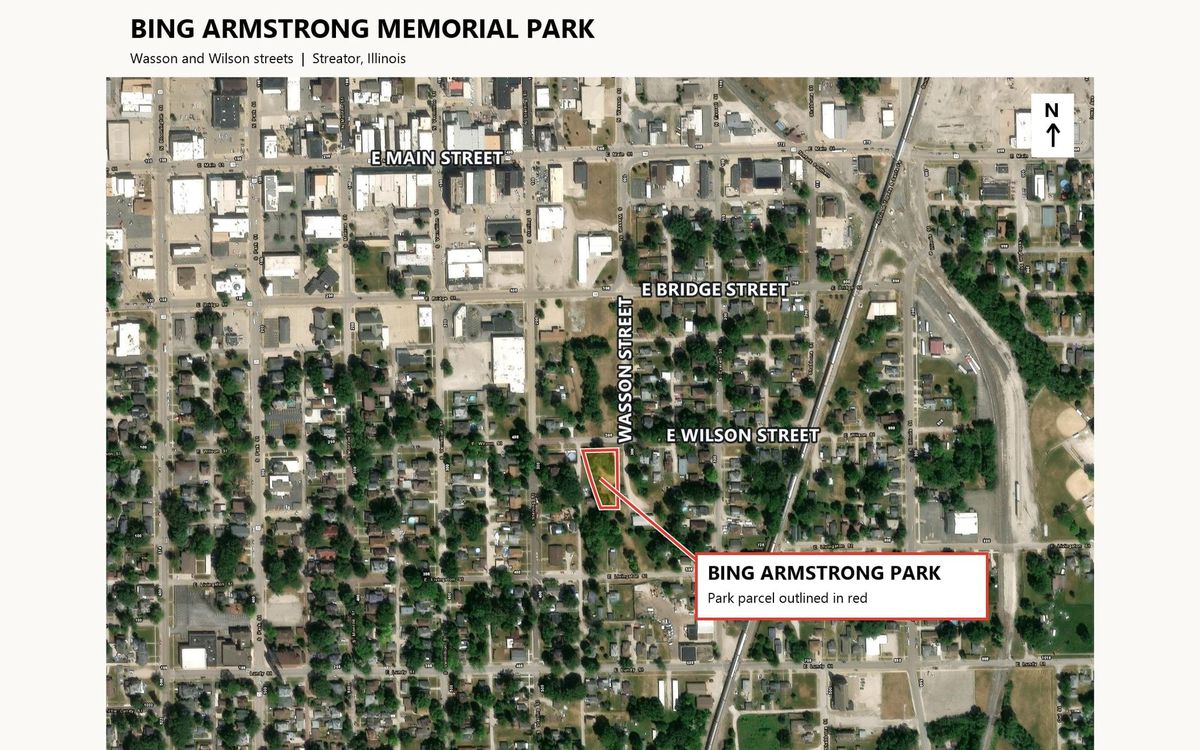
The improvement proposed for Bing Armstrong Memorial Park comes with an unusual feature for a neighborhood park: private ownership.
In September, city staff recommended advertising the roughly half-acre property at Wasson and Wilson streets for sale, contingent on the purchaser building homes. Council has not yet acted on the recommendation.
There is a reasonable case for housing. New homes could bring residents, investment and property-tax revenue to an established neighborhood. A city hoping to strengthen its older blocks should welcome people willing to build on them.
But before we congratulate ourselves on finding a productive use for a former playground, it seems worth remembering why the playground was there.
According to the staff memorandum included in the September 2 council packet, Bing Armstrong Memorial Park was established in 1998. The park is named for local resident Bernard “Bing” Armstrong, according to Streator’s tourism website. For nearly three decades, the property has carried a name and a neighborhood purpose.
That history does not settle its future. It does suggest that the decision deserves more consideration than the disposal of an ordinary vacant lot.
The path to the housing proposal began before this year.
On August 21, 2024, the City Council unanimously accepted a Park and Open Spaces Board recommendation to eliminate Bing Armstrong Park as a playground. The meeting minutes record concerns about unsafe equipment and low use. Mayor Tara Bedei reported that the equipment had been installed in 2006 and needed upgrading.
To be fair, the city described the playground as underused before the equipment came out. Its assessment was not based solely on an empty lot after the swings disappeared.
But low use still invites questions. Was the equipment deteriorating? Had the neighborhood’s needs changed? Would a different kind of public space have worked better?
The 2026 memorandum emphasizes vandalism and deterioration, while the 2024 minutes emphasized safety and low use. Those explanations can coexist, but they leave room for a clearer account of how equipment condition, vandalism and neighborhood demand influenced the decisions.
The memorandum says the playground equipment was removed in 2024 and the park sign was subsequently taken down. What remained was primarily open green space with several mature trees.
After the equipment’s removal, the city received an inquiry about private acquisition and residential development.
The memorandum does not identify who made that inquiry, provide an appraisal or estimated sale value, or describe a specific development plan. It identifies the possibility of one or more homes and recommends seeking bids contingent on residential construction.
Those details would help residents evaluate the proposal. One house, several homes and a parcel held indefinitely for future development offer different benefits to the neighborhood.
The same memorandum also identifies another possibility: adding park amenities, with funding to be budgeted in 2027 depending on direction from the Park Board and council.
That is an alternative on paper. Making it a fair comparison requires a proposed use, an estimated cost and an explanation of who would maintain it.
Neither option is free. Selling involves appraisal, advertising and legal expenses. Reinvestment requires money for improvements and a commitment to upkeep.
Municipal progress, unfortunately, continues to resist the invention of a maintenance-free version.
The Park Board’s own concerns make the funding question more pressing. In June 2026 minutes included in the August board packet, members questioned their role in decisions and their ability to advance projects with limited funding. Those comments concerned the park system generally, but an alternative dependent on that board’s direction needs a clear process and a realistic funding path to become more than a budget-season possibility.
There is much to like about building homes within an existing neighborhood. Done well, it can strengthen the blocks Streator already has.
There is also much to like about a small public space close enough to use without arranging a family expedition. A neighborhood park serves a different purpose from a destination park across town. Its value may lie in being ordinary, nearby and available on an otherwise uneventful afternoon.
A credible comparison should give both possibilities a fair hearing.
For housing, that means explaining what would be built, on what timetable, and with what enforceable commitment to finish. Sale proceeds and future property taxes belong in the calculation, alongside any public costs needed to support the development.
For continued public use, it means asking nearby residents what they would use and pricing a practical option, including maintenance. Perhaps that would support renewed investment. Perhaps it would show that housing offers the greater neighborhood benefit.
The park’s memorial identity deserves attention, too. A decision about the land should include an explanation of how its name and history would be treated, with an opportunity for the Armstrong family to be heard.
None of this requires preserving every public parcel forever. It requires being specific about what the neighborhood gains when one changes hands.
Taking mowing, equipment replacement and liability off the city’s books could be a legitimate benefit. Residents should also be able to see what they receive in return: completed homes, a stronger block, or another clearly defined improvement.
Streator’s past gives us plenty of reasons to believe people can build worthwhile things together. Its future deserves that same confidence, supported by careful decisions about the places earlier generations left us.
Bing Armstrong Park may ultimately become a good place to live.
The neighborhood deserves a clear answer about whether it could still be a good place to gather.