Bryan Park Knows Where He Comes From
Before Bryan Park ever wore the chief’s badge, before the radios and reports and emergency operations meetings, he was a kid on East Wilson Street with a bike, a glove, a bottle of Red Cream Soda and a working knowledge of every place a boy could spend a summer day in Streator.
He grew up on the 1100 block of East Wilson, “just down the street from Bodznick and Southside,” where he and his brother and friends played wiffleball and baseball. He rode his bike everywhere. He spent his money on baseball cards, candy and, by his own admission, “probably some fireworks at Med-O-King Grocery.” He played pickle at Owens ballfield. On cold nights, he remembers being outside and still feeling “the warm feel of Streator Bulldogs basketball” inside what is now Pops Dale Gymnasium.
“I guess you could say I was the typical Streator kid in the 1980s,” Park said.
That is one way to introduce him. Another is the way he introduced himself.
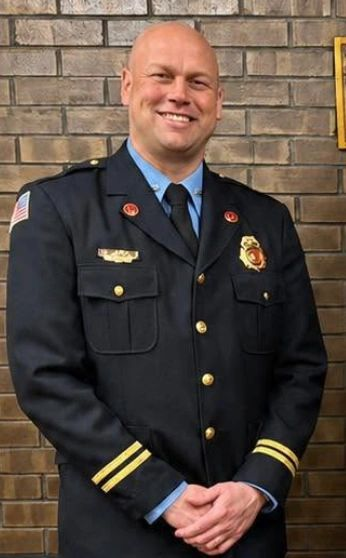
“My name is Bryan Park. I’m 49 years old,” he said. “I’m a dad, a husband, and was recently named the Fire Chief of the Streator Fire Department.”
Then he added the line that seems to explain the rest of the story.
“I’m a proud Streatorite. I was born and raised in Streator and molded by our community.”
Park’s appointment as fire chief comes after 24 years with the Streator Fire Department, years that began with uncertainty and became, in his words, “my life’s work to give back to our community.”
He is also a husband and father. His wife, Tiffany, is an English teacher at Streator High School. Their daughter, Ella, is 19 and studying social work at Illinois State University. Their son, Tyler, is 15 and a sophomore at Streator High School.
“Family is everything,” Park said, “and I couldn’t be more proud of the young adults our kids are becoming.”
He is also a coach, which in Streator can be almost as public a job as anything at City Hall. Park has been an assistant basketball coach at Streator High School for 17 years. He served five years as president of Streator Youth Soccer and 10 years on its board. He has spent much of his life away from the station in gyms, on fields and around young people.
“I’ve filled my time away from work in many different ways to give back to the youth of Streator,” he said.
That phrase, “give back,” can get worn thin in public life. It can become something people say before they ask for a budget increase or pose for a photograph. But in Park’s case, the phrase seems less like a slogan than a through line. He came from a town he believes helped raise him. He chose a job that sends him back into that town at the worst moments in people’s lives.
“I’ve always looked at my profession as a way to give back to the people of our city,” Park said.
Privileged To Not Be Privileged
Park does not describe his childhood as hardship, but he does not dress it up as ease either.
“I like to tell people that I was privileged to not be privileged as a kid,” he said. “My parents provided for my brother and I but I’m grateful that nothing was ever just given to us. My parents made sure that we always worked for anything we had.”
That lesson, he said, looked a lot like Streator itself.
“Our community is full of hard-working people that have had to earn their living,” Park said. “I’ve always felt fortunate I learned those important life lessons as a kid.”
There is something recognizably Streator in that. It is not the polished booster-poster version of town, all murals and slogans and cheerful announcements. It is the older thing underneath: work, family, church, ballfields, neighborhood adults, familiar faces and the expectation that you help when help is needed.
“Streator taught me community and that helping one another is just something you do,” Park said. “It has probably influenced my career in the fire service; knowing that helping people is just something that has always been natural.”
Park graduated from Streator High School in 1995 and later earned a degree in economics from Illinois State University. The fire service was not part of some childhood master plan.
“The journey to find my career wasn’t a straight line,” he said. “Being a firefighter wasn’t my intention while in school. In fact, I had no idea what I wanted to be or do; just like many young adults I suppose. To be honest, becoming a firefighter was just a gamble I took.”
After college, Park worked for a bank in Bloomington as a mortgage underwriter. The job came with a cubicle in the basement.
“There were no windows; just three tight walls,” he said. “I was bored and quickly realized that doing the same thing every day wasn’t for me.”
Around that time, he saw the Streator Fire Department was testing for new firefighters. Some friends and former firefighters offered the practical advice: “work with your head, not your back.”
Park tested anyway.
“I was fortunate to test well and was hired as a Streator firefighter,” he said. “My first day was July 7, 2002. Being a firefighter fit me perfectly.”
The Superheroes At The Plumb Hotel
Park’s first memory of firefighting goes back well before he joined the department. It came during one of the Plumb Hotel fires, around 1987. His father, Harry Park, worked for the Streator Public Works Department, and young Bryan tagged along as his dad placed barricades in the street.
“I remember seeing Streator firefighters entering the smoky building and thinking they had to be something like superheroes,” Park said.
Years later, after he became one of them, that image changed.
“Through my career, it has become apparent that firefighters are not superheroes like I had thought so many years ago,” he said. “We are just people trained to help others.”
The first few shifts made clear how much training would be required. Park remembers riding to a grass fire in Engine 1 with Captain Terry Leonard. He sat in the officer seat because he was not ready to drive a fire truck. The siren blared almost the entire way.
“It wasn’t until we had nearly arrived that I asked Captain Leonard if he normally used the siren so much,” Park said. “He pointed to the foot pedal my boot was on and told me I was the one sounding the siren so much.”
He was, as he put it, “very green.”
But he learned quickly. He credits the firefighters who trained him and the department culture he entered.
“The Streator Fire Department has always been known for our aggressive, interior fire attack and I enjoyed training and learning those tactics,” Park said. “The department has always worked hard to get to the fire quickly and to get water on the fire fast.”
The first years, he said, gave him a foundation.
The rest of his career gave him a philosophy.
The People Who Shaped Him
When Park talks about leadership, he does not start with a management book. He starts with his father.
“My Dad was my role model and my best friend for so long,” Park said.
Harry Park died recently, after his son’s first week as interim chief. Park said he is grateful his father got to see him in the role, even briefly.
“I learned so much from him; most importantly, to treat people with respect, to work hard at everything I do, and to be a servant leader,” Park said. “Dad was the ultimate team player and always acted for the betterment of the team.”
Park also points to Streator High School boys basketball coach Beau Doty, whom he has coached beside for 17 years.
“Beau has taught me a balance on how to be a friend/mentor and when to be a boss/coach,” Park said. “I’ve learned when it’s time to be understanding and when it’s time to discipline.”
He credits retired Fire Chief Gary Bird with mentoring him in the fire service and showing him “how to create and embrace change.”
“Handling personalities is a big part of any leadership role,” Park said.
That is where coaching and firefighting begin to overlap. A fire station is not so different from a locker room in one respect. A group of people with different personalities has to become one team before the pressure arrives.
“Being an effective coach and leader requires taking a group of unlike individuals and moving them forward as a team towards a like goal,” Park said.
That sounds simple until the tones drop.
Drinking From The Fire Hose
Park’s leadership change officially took effect June 8. Almost immediately, the department and the city were tested by serious events, including a tornado and a series of fires being investigated as arson.
“Around the station, we have jokingly said it has been like drinking water from a fire hose,” Park said, “and at times it has certainly felt that way.”
Those early weeks showed him the strength of the department.
“We have strong leaders and dedicated firefighters who are willing to do whatever it takes for our community,” Park said. “These weeks have tested our resolve and commitment, and we’ve shown what we are capable of.”
He is careful not to claim perfection. That is a good sign. Institutions that say everything went perfectly usually have not looked closely enough.
But Park said the department performed as it should during the tornado, and he believes the events will make the department better.
On a personal level, the stretch confirmed something for him.
“Even when faced with destruction, chaos, and uncertainty, I am ready for the role and prepared to handle major incidents,” he said.
He also learned, or perhaps had confirmed, the weight of the job.
“Having this job in this community is both an honor and a heavy responsibility,” Park said. “Overseeing emergency response and the safety and well-being of the people of Streator is something I will never take lightly.”
The tornado response also revealed a side of city government most residents never see. The public sees the fire trucks, ambulances and police cars. It sees flashing lights and crews on the street. What it does not see is the structure being built behind the response.
Park said major incidents require a broad incident command structure. On the night the tornado hit, firefighters, police and public works crews were active in the damaged areas. Behind the scenes, city employees were setting up an Emergency Operations Center in the City Hall council chambers.
The EOC became, Park said, “the decision, logistics, and communications hub for the entire city throughout the incident.”
It included city officials, department heads, county emergency managers, IEMA, Nicor, ComEd, the Salvation Army and the American Red Cross. For 10 days after the tornado, the group met each morning to set objectives, share updates, identify needs and build a response plan.
“The Streator EOC did everything from making the highest-level decisions to fueling light tower generators,” Park said. “The EOC is a great example of what our community can do when we pull together.”
That is the part of public service that never fits neatly into a campaign slogan. Somebody has to make decisions. Somebody has to move barricades. Somebody has to fuel the generator.
Preparedness Saved Lives
Park said Streator was fortunate to avoid fatalities or major injuries in the tornado, especially given the catastrophic damage to some homes and the EF-3 rating.
He points to preparedness as one reason.
“One Streator resident laid in a bathtub as the home was destroyed,” he said. “One resident hid in a closet as the roof was taken off. They both talked about having established their safe spots years ago.”
Park wants residents to understand that warning systems are layered. Sirens are not designed to be heard inside homes. They are outdoor warning sirens.
“If you hear a siren in Streator, it’s a dangerous situation,” he said, adding there is no “all clear” siren.
Phones are now a major warning source. Weather radios remain one of the most reliable tools. Park also credited the National Weather Service for giving Streator roughly 30 minutes of warning before the tornado struck. He said Streatorland tornado sirens were activated at least 10 times.
“Streator was prepared for the extreme weather,” Park said. “It is proof that preparation and response saved lives.”
The Modern Fire Department
One of Park’s priorities is helping the public understand what the modern fire department has become.
“Traditional fire departments generally concentrated solely on fire suppression,” he said. “If there was a fire, the fire department was there.”
That is no longer the job. Today’s fire departments operate with what Park calls an “all hazards” approach, covering fire suppression, auto extrication, disaster preparedness, technical rescue, hazardous materials response, emergency medical services and community risk reduction.
“In general, the modern fire department has ultimately turned into the community ‘fix it’ service,” Park said. “Now if there is any problem, the fire department will be there.”
That expansion has changed the workload. Park said Streator’s department responded to about 600 calls per year two decades ago. In 2025, he said, it responded to 3,529 calls for service.
“The fire service in general needs to do a better job of informing the public of the changes we’ve made and how we’ve become a more valuable part our community,” he said.
The department’s strengths, Park said, are its people, station and equipment. Its challenge, as always, is funding.
“We understand nobody likes to pay taxes and tax increases are difficult to swallow,” he said. “Because of that, our goal as a fire department is to remain as fiscally responsible as possible.”
Costs are rising. Park said the price of a new fire engine has doubled over the past nine years. The department will continue looking for grants and other income sources to keep services cost effective.
That is the uncomfortable balance of local government. Everyone wants the truck to arrive fast, fully staffed and fully equipped. Nobody is excited about the bill. Good leadership does not pretend that tension disappears. It explains it honestly and manages it carefully.
Moving The Department Forward
When Park thinks about how he wants his time as chief to be remembered, he gives three answers.
“A better service. A better place to work. A bigger part of our community.”
He wants the department to keep improving. He wants firefighters, EMTs and paramedics to come to work and feel the station is a good place to be. And he wants the fire department to be more visible and involved in community groups and events.
“In the end,” Park said, “I’d really just like to be known as a chief that treated everyone fairly and moved our department forward into a sustainable future.”
There is a lot packed into that word, sustainable. It means budgets that can hold. Equipment that can be replaced. People who can do hard work without being ground down by it. A department that does not only respond to the next emergency, but prepares for the next decade.
Park’s story is not the story of someone who escaped Streator and came back to rescue it. It is the story of someone who was formed by the place and stayed. The kid from East Wilson Street grew up, traded the bike for a fire truck, learned to stop stepping on the siren pedal, and eventually took responsibility for the department he once watched enter the smoke.
The superheroes, he learned, were just people trained to help others.
Now he is responsible for helping them do it.
Source: Bryan Park’s written responses to The Streator Standard.