The Silent March Toward a Downtown Disaster
Somewhere between City Hall and the wrecking ball, the public got cut out of the conversation.
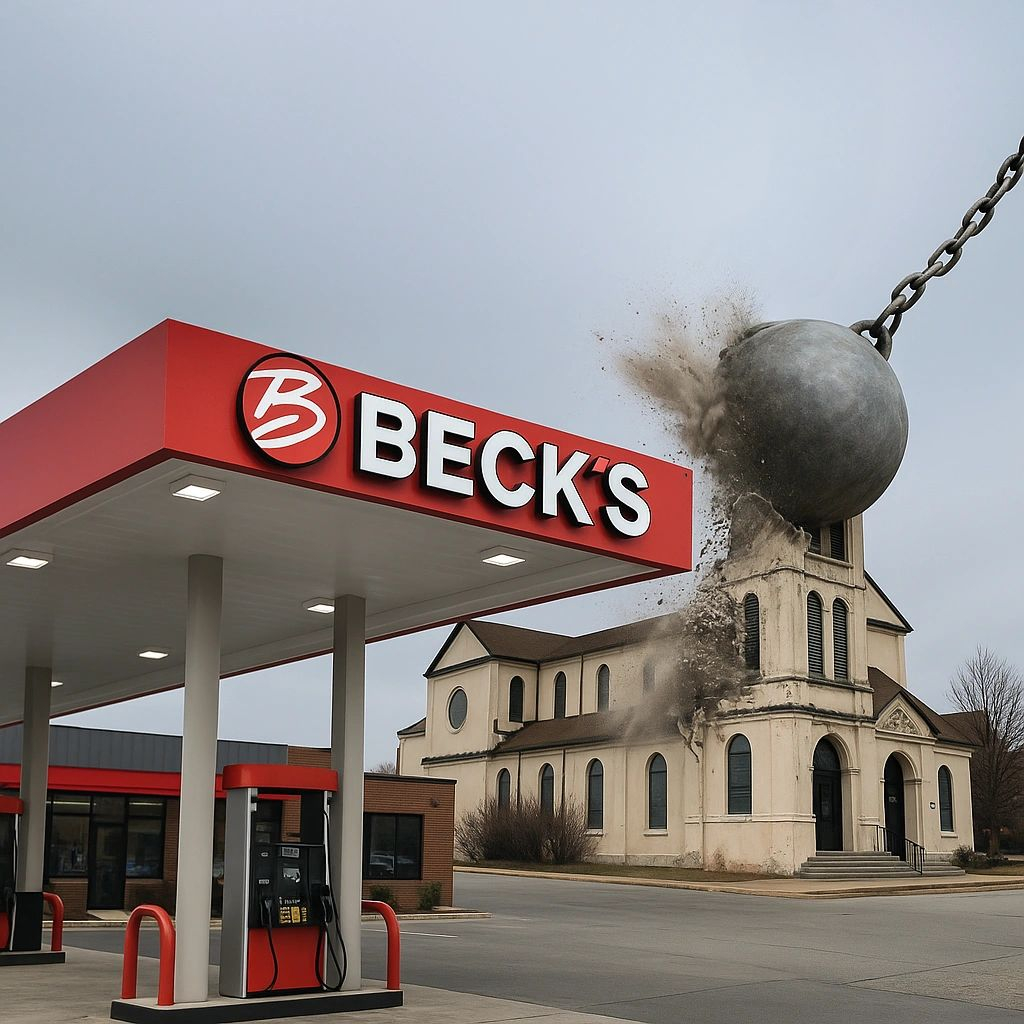
Streator is on the verge of approving one of the most consequential development deals in years—demolishing a historic church and an entire city block to make way for a giant Beck’s gas station on the edge of City Park—and the people in charge haven’t bothered to tell us why. Not a press release. Not a public statement. Not even a vague gesture at how this fits into any larger vision for the city.
At the only public hearing so far—on the TIF redistricting required for the project—every single speaker opposed the plan. Every. Single. One. You’d think that might prompt our leaders to address the concerns head-on. Instead, they’ve taken the “hear no evil, see no evil” approach, letting the clock run out until they can rubber-stamp the deal.
Mayor Tara Bedei’s Facebook update says it all: Beck’s “will be discussed tonight, and agreement most likely voted on next week,” with demolition starting this winter. That’s not leadership—that’s stage-managing the illusion of public process. Decisions have already been made. The meeting is just the formality.
And the irony? It’s thick enough to pave over the whole block. In the same post, Bedei says an Arby’s development is delayed because the site is a former gas station, which required extra soil testing and remediation. Translation: gas stations leave a toxic mess that’s expensive to clean up. So naturally, we’re going to put a brand-new one directly next to our central park.
Even if you ignore the location and the hypocrisy, the economics of this are rotten. Studies from the National Trust for Historic Preservation’s Older, Smaller, Better project show that blocks of older, smaller buildings outperform areas dominated by big, new, single-use projects on nearly every measure that matters—jobs, small business growth, and property value per acre. Those older buildings aren’t just quaint—they’re engines for local wealth. Tear them down for a mega-pump island, and you get a short-term tax blip followed by decades of mediocrity.
Strong Towns has been sounding the alarm for years: cities bankrupt themselves chasing “big wins” like this. A large gas station creates the illusion of progress, but it’s a dead-end street. Low-density, single-use development can’t pay for its own infrastructure upkeep. When the shine wears off and sales plateau, the city is left with the bill for maintenance, the risk of environmental cleanup, and a site that’s nearly impossible to repurpose without another round of subsidies.
And yet, here we are—gutting a block of historic character for a project whose long-term return is likely worse than the status quo. This isn’t just bad planning. It’s the civic equivalent of selling the family silver to buy a deep fryer.
The most galling part? No one at City Hall has stood in front of the public and explained how this serves our future. No comparisons of projected revenues versus other potential uses. No explanation of how it fits into the city’s own strategic or downtown plans. No acknowledgment that it trades away irreplaceable assets for a project we’ll still be paying for long after the ribbon-cutting photos have yellowed.
If this is truly the future our leaders believe in, they should be proud enough to defend it in the open. If they can’t—or won’t—it’s because deep down they know what it really is: a short-term photo op, bought with long-term debt and the demolition of what makes Streator worth caring about.
This is how cities die—not with a bang, but with a handshake in a closed room.
Streator City Council will meet Tuesday August 12th in the City Council chambers at 7 pm to discuss the Beck's development and other items.