The Report Card Number That Should Worry Streator Most
A third of Streator High students miss weeks of school every year, and the problem started well before COVID.
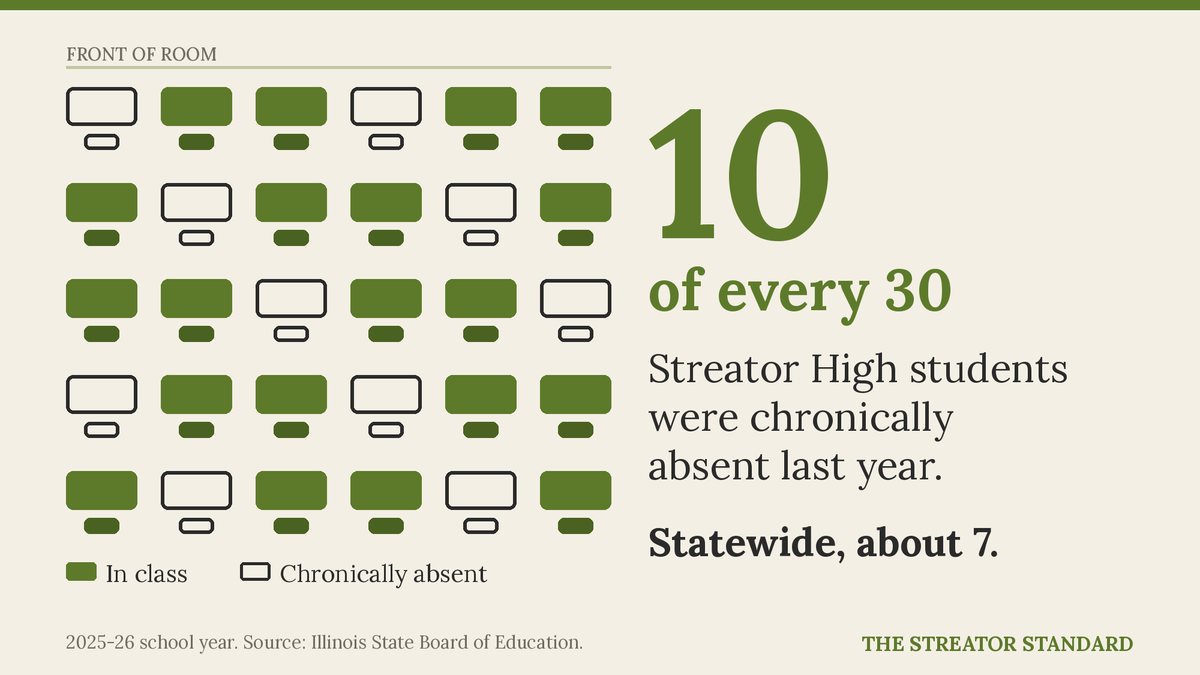
Last year, one in three students at Streator Township High School missed at least 17 days of class.
The state calls that chronic absence, missing 10% or more of the school year for any reason, excused or not. At Streator High the rate was 33.2%. Statewide it was 23.5%. At Seneca it was 15.3%, and at Dwight 13.9%.
That number got less attention than the label on the school's report card when the state released it Oct. 30. Streator High was rated "Developing," the second-lowest of five ratings and the only one among seven area high schools.
The label deserves less alarm than it got. Illinois rebuilt its rating system this year. Under the old one, nearly three-quarters of schools were rated Commendable, Streator High included. The school did not fall off a cliff in a year. The state started drawing finer lines.
The record underneath the label has not changed much. Four in five Streator High students graduate in four years, against nine in 10 statewide. One in three juniors met the state's reading standard. One in five met it in math.
None of those numbers will move much while a third of the students are not in the building.

Older than COVID
The easy explanation is the pandemic. It does not fit the record.
In 2018 and 2019, about a third of Streator High students were already chronically absent. The state rate was about 17%. By our count from the state's school files, Streator's rate was higher than roughly 80% of Illinois high schools.
The state has tracked a plainer measure for much longer, the share of school days students attend. For most years since the 1990s, Streator High ran within a point or two of the state. It matched or beat Illinois in 2000 and 2001 and came within a few tenths of a point in 2013 and 2014.
Starting in 2015, it ran two to three points behind every year until the pandemic, the longest such stretch in the state's records. Whatever changed, it changed before COVID.
The pandemic made it worse. In 2021-22, the first full year back in classrooms, chronic absence at Streator High reached 51.6%. The state hit a record 29.8%, and Ottawa reached 48.5%, so Streator was not alone. But the typical Illinois high school rose about 11 points from 2019 to 2022. Streator rose almost 18.

By 2023-24, Streator's rate had fallen to 27.7%, within about a point and a half of the state, which had dropped more slowly to 26.3%. We don't know why. Streator had further to fall, quarantines ended, and the district's own work may deserve some credit. The records don't say.
Then the rate climbed again, to 32.4% in 2024-25 and 33.2% last year, while the state's kept falling. Streator is back where it was before COVID, about 10 points above Illinois.
A schoolwide average hides this. Streator High's attendance rate last year was less than two points below the state's, which sounds close. It describes the same school where a third of the students missed at least a tenth of the year. The average tells you how the building did. Chronic absence tells you how many students are falling behind.
Mostly excused
When people hear that kids are missing school, they picture kids skipping. At Streator High, the numbers point somewhere else.
Illinois also counts chronic truants, students who miss 5% or more of the year without a valid excuse. Last year Streator High's chronic truancy rate was 15%, below the state's 19.3%.
Streator's chronic truancy rate was lower than the state's. Its chronic absence rate was far higher.

The two measures use different rules, so one can't be subtracted from the other to count students. But the gap between them was about 18 points at Streator last year and about 4 statewide. In every year the state has reported both, back to 2018, Streator's gap has run between about 15 and 28 points, except in the remote-learning year of 2020-21. Statewide it has never topped about 8.
That suggests many of the students missing serious time have absences the school counts as excused. Illness, medical appointments, family emergencies and concerns about a student's health or safety can all be valid reasons under Illinois law. At Streator High, it is up to a parent to excuse an absence.
We don't know which reasons account for Streator's unusually high rate. It is unusual enough to be worth finding out.
It also says something about the tools. A truancy board deals with unexcused absences. It was not built to reach a student whose absences are excused.
What the district has done
The school's 2022-23 discipline report lists what was in place then. A truancy board that meets every other week. A truancy mentor. Two social workers and three counselors. An in-house alternative school. Monthly attendance rewards.
Those are real efforts, and the rate has climbed back above 30% since they were listed. The district has programs. It has not shown whether they work.
In July, the school announced new attendance rules for this year. Parents have seven days to excuse an absence. After that, it stays unexcused, and students with unexcused absences cannot make up missed work, according to the announcement.
Those rules govern how absences are recorded and what happens after one. They do not say why so many students are missing school or how the district plans to bring the number down. And changing whether an absence counts as excused does not change whether a student is chronically absent. The state counts both.
The rules took effect this fall, so they had nothing to do with last year's numbers. Whether they help is a fair question for next year's report card.
Since 2018, state law has required every Illinois district to collect and review its chronic absence data and decide what support students and families need. We read every set of District 40 board minutes from 2019 through this August and found no discussion of why a third of students are chronically absent or what the plan is.
Some of the causes are bigger than any school. More than half of Streator High students come from low-income families. Last year 24.8% of students transferred in or out during the school year, nearly double any year since the state changed how it counts in 2017 and more than three times the state rate. Each of those moves is a student starting over in the middle of a year.
Those are community problems as much as school problems. The school is still where they show up, and it is the only institution that counts them.
There are signs the school is not hearing much back, either. Each spring the state surveys students and teachers on five measures of how a school works. Over the last four years, Streator High was rated Neutral, the middle of five levels, on 18 of 20 ratings. The other two were Weak, both for Involved Families, in each of the last two years. That rating comes mostly from what teachers report about whether the school and parents work together.
Last spring only 52% of Streator High students took the survey, down from 95% three years earlier. The state average is above 90%. We don't know why.
A goal for the money
On one thing, District 40 has done what plenty of public bodies never manage. It set a hard target, tracked it and beat it.
The district ran deficits of nearly $1 million in 2014 and 2015, when the state was skipping payments. Its main fund was down to $2.3 million. Then came the state's new funding formula in 2018, federal pandemic money and rising property values, wind farms included. The 2021 strategic plan called for 12 months of reserves within 10 years. The district got there in three.
That fund now holds $13.2 million, more than a year of spending. Across all its operating funds the district holds nearly $21 million, though some of that is set aside by law for uses like buildings and transportation.
Over the same 11 years, Streator High's four-year graduation rate went from 76.5% to 80.9%. The state's went from 85.3% to 89.8%. Streator trails by about the same margin it did in 2015 and has never caught up in between.

Junior test scores trail the state by wide margins too. Illinois has changed its high school test and its passing scores in recent years, so those results don't line up cleanly across a decade. Graduation rates do. Meanwhile, enrollment fell from 953 students in 2016 to 722, nearly a quarter.
One fairness note. The state's formula says District 40 has about 76% of what it needs to adequately educate its students. A reserve and yearly adequacy are different measurements, and a district can be short on one while flush on the other.
We don't think the district spent its money badly. It measured its bank balance closely and its students loosely, and the balance sheet improved faster than the results.
The schedule
The loudest school fight in Streator over the last few years was about the bell schedule. We will have more to say about it in a separate story.
In 2020 the board adopted an eight-class block schedule after two years of study. In September 2023 it voted 5-2 to drop it, citing money. A 400-signature student petition, a letter from 48 teachers and 14 speakers asked the board to keep it. No one spoke for the change. The main discussion happened in closed session.
The audited books show the main fund ran a surplus every year, including all three block years, and held $8.4 million when the board voted. The projected savings were $130,000 to $160,000, about 1% of what that fund spends in a year.
The district was not in financial trouble. It cited cost to end a schedule that hundreds of students and dozens of teachers asked to keep, while its reserves kept growing. Reasonable people can defend that decision. The town should know how it was made.
Since the switch, the minimum enrollment to run a class rose from 10 students to 15, and roughly a dozen classes stopped running, including some dual-credit courses. German is ending with a retirement. Career and technical concentrators fell from 290 in the last block year to 213 the year after.
Whether the schedule helped or hurt test scores, the numbers can't say. Too much else changed at the same time. The district made the decision on a projection. Two years in, it has the real figures for what it saved and what it cost in courses. It should share them.
Why it reaches past the school
Nearly every young person in Streator passes through this building. Last year 56% of its graduates were in college within a year. The rest went to work, the military or somewhere else, and many of them are the people local employers will hire. Incentives can bring an employer to town. They can't supply the skills the job needs.
Families with a choice of where to live look at school ratings, and few of them will read the fine print on a new rating system.
It is also public money. District 40 spends about $22,000 per student, most of it from local property taxes and state aid. Its reserves are public money that has not yet been spent on a student.
What should come next
Some numbers are already moving the right way. Freshman math scores jumped last spring, and math growth is now at the state average. The teachers who filled the auditorium in 2023 are the kind of staff any district would want.
The district should start by putting its State of the District report online. The superintendent presents one every June with class sizes, grades, attendance and finances. It goes to board members in a packet, and we could not find it anywhere online. It is the one document that would let the town judge the school for itself.
The board should explain the attendance number in public and set a target for next year, an actual number with a plan behind it. It should also share what is behind the number, how much of the missed time is excused, how much is not and the most common reasons, so everyone trying to help knows what they are working with. The state already requires it to review that data. Publishing it would cost nothing.
It should set the same kind of goal for graduation and test scores that it set for reserves, say where it wants them in three to five years and report against that goal every year.
And it should spend some of the cushion. Twelve months of reserves was the goal, and the goal has been met. Research on attendance shows that mentoring works and that regular, inexpensive contact with parents helps. Research on learning loss shows that intensive tutoring during the school day works. Both cost money. The district has it.
The obvious objection is that one-time money can't pay for permanent staff. True enough. That argues for choosing carefully and finding recurring revenue to keep what works. It doesn't argue for leaving the money where it is.
The rest of town has a part too. Employers who hire students can schedule around school hours and back up regular attendance. Churches, clubs and retirees can mentor. Parents can ask the school for help before absences pile up, and the school should make that easy.
District 40 has already shown it can set a hard number, track it every year and beat it early.
It did that with its savings.
Attendance should be next.
Editor's note: The Standard sent written questions to District 40 Superintendent Scott Cameron on Nov. 2. Cameron requested an in-person meeting and the writer's name. The Standard conducts its interviews in writing and publishes anonymously. We invited the district to provide written responses by 5 p.m. Nov. 6. The district did not provide any. We will publish a substantive response if one arrives.