Digging Into Streator’s Past: The Story Beneath Our Feet
When we talk about Streator’s history, we usually mean the last 150 years or so—the coal boom, the glass factories, the neighborhoods with names like Twister Hill. But the real story goes back hundreds of millions of years, long before a grocery store called Hardscrabble opened its doors on the Vermilion.
To understand Streator, you have to understand the earth beneath it. And to do that, you have to try to imagine a world so different from our own it almost feels like a dream.
Illinois, 300 Million Years Ago
Picture central Illinois 300 million years ago. Not the cornfields we know, but a steaming, tropical swamp. The land we now walk was near the equator, part of a vast continent called Pangaea. The air was heavy with moisture, the forests thick with giant ferns, spindly trees, and plants that looked like something out of a child’s imagination. Insects the size of hawks flitted overhead, and strange amphibians slithered in the muck.
There were no birds, no grass, no cornfields—just endless swamps of green, and waterlogged ground that swallowed the plants whole when they fell.
How Coal Was Born
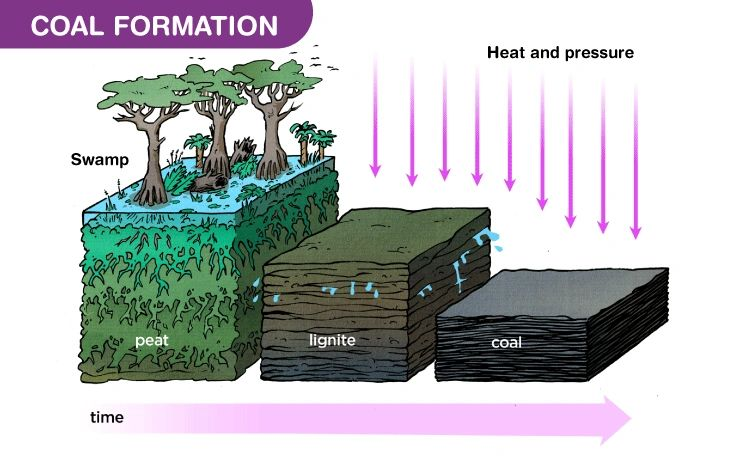
Normally, fallen plants rot away. But in these swamps, the water was still and oxygen was scarce. Instead of rotting, the plants piled up in soggy mats of half-decayed material called peat. Imagine a wet sponge made of leaves and stems, stretching for miles.
Over time, floods and storms buried the peat under layers of mud and sand. Each new layer pressed harder on the plants below, squeezing out water and gases. The deeper the burial, the hotter it got. Slowly, over millions of years, the pressure and heat transformed the peat into coal.
It happened again and again. Layer upon layer of ancient swamp forest, compacted into black seams that ran under the Vermilion valley. What began as dragonflies buzzing above giant ferns became the fuel that fired locomotives, powered glass furnaces, and gave Streator its first great boom.
Sand That Shined Like Opportunity
Coal wasn’t Streator’s only gift. Buried nearby were layers of silica sand, pure and fine, remnants of ancient seas. With coal for fire and sand for glass, the earth had already written the recipe for industry. All we had to do was show up and follow the instructions.
The furnaces roared, and Streator became the “Glass Capital of the World.” German glassblowers came, settled on Twister Hill, and filled the air with the glow of molten bottles. Beer and soda traveled the country in glass born of our sand, melted in our fire.
The Glaciers’ Legacy
Then came the Ice Age, much later in the story. Glaciers rolled down over Illinois, grinding rock to clay and silt. When they melted, they left behind some of the richest soils in the world. Winds blew fine dust—loess—over the land, like flour sifted across a counter, sealing the gift.
Those soils are still here, still feeding us, still one of Streator’s quietest treasures. And the Vermilion River—always cutting, carving, revealing—ties the whole story together. It exposed bits of the old coal and sandstone, carved bluffs that still stand, and gave the first settlers a reason to stop.
The River Still Runs
Coal built the boomtown. Sand lit the furnaces. Glaciers laid the farmland. And through it all, the Vermilion still flows. If you stand on its banks today, you’re standing at the crossroads of deep time—where swamps turned into coal, where glaciers spread their gifts, where settlers once watched wagons struggle up muddy slopes and laughed that it was all just a “hard scrabble.”
Our Future, Still in the Ground
It’s dizzying to imagine: dragonflies the size of hawks buzzing in a swamp that no longer exists, their bodies pressed into the seams that made Streator possible. But that’s what lies beneath our feet. Coal and glass have gone quiet, but the soil still grows, the river still runs, and the land still carries gifts we’ve yet to recognize.
Maybe the next prosperity isn’t in digging deeper, but in finally looking around. In treating the Vermilion as more than a mural. In treasuring the farmland not as background but as opportunity. In finding new ways to work with the same earth that made us.
The ground has always been Streator’s greatest ally. It gave us one prosperity already. If we learn to listen again—to the soils, the sand, the river—it might just give us another.
Because here, more than most places, the past and the future are both written in the same place: the earth beneath our feet.