Streator's Deadly Winter of 1907
By the end of March, at least 10 residents were dead. For weeks, Streator had struggled to understand what was happening.
STREATOR — Mabel Fraser died at 7:30 on the morning of Feb. 22, 1907, in a Streator hospital.
She was 31 years old and had married her husband, Norman, in Michigan about three and a half years earlier. She had spent the previous three weeks battling what the newspaper called "typhoid-pneumonia."
Her body was taken to her father-in-law's home on Court Street. At the funeral at Park Presbyterian Church, the paper noted, the casket would not be opened.
That same morning, a bacteriologist from Chicago was out at the city's waterworks on the Vermilion River.
Streator knew the sickness was typhoid. What no one could say for certain was where it was coming from. Doctors suspected the wells. Others blamed the milk. Some pointed to the city water itself.
Fraser was one of at least 10 people the Streator Daily Free Press reported dead of typhoid that winter. They included children, factory workers, a coal miner and a young teacher.
A warning from 1883
The danger had been recognized more than 20 years earlier.
In August 1883, as Streator debated building a waterworks, the city's water commissioners warned against drinking from the Vermilion. One of them was Dr. Edwin Evans, the town's leading scientific voice.
The river was too small and too unreliable, their report said, and its water "might generate disease." In dry summers it shrank to a chain of ponds where cattle and hogs stood to keep cool.
They doubted filters could fix it. "Can the leaven, whatever it may be, that generates bilious and typhoid fevers, and cholera, be filtered out of water?" the report asked. "It never has been."
Streator eventually entrusted its water supply to a private company. The Streator Aqueduct Co. began operating in 1886, drawing first from Otter Creek. When that supply proved inadequate, and efforts to supplement it with well water failed, the company turned to the Vermilion. It built its plant about three miles upstream from the city.
"Just the cause for this is not explained"
The first signs of trouble in 1907 appeared weeks before Fraser became ill.
On Jan. 5, the Streator Daily Free Press reported "numerous cases of typhoid fever in the city," adding that "just the cause for this is not explained."
Some doctors were warning residents against drinking well water. The city's own supply, pumped from the river by the privately owned Aqueduct Co., was supposed to be safer. It had been tested repeatedly, the newspaper reported, without revealing any dangerous germs.
Typhoid fever spreads through food or water contaminated with human waste. The disease can cause prolonged high fever, weakness and serious intestinal complications. In 1907, there were no antibiotics to treat it. Patients could spend weeks fighting for their lives, and some never recovered.
The uncertainty created an opportunity for at least one downtown business.
On Jan. 10, Powers & Williams Hardware Emporium began advertising a household water filter under the headline "No Typhoid Fever."
The Pasteur filter cost $6, a considerable purchase for many families. But the advertisement argued that "the cost is a trifle when you consider what sickness it may prevent."
The store repeated the advertisement 15 times over the next six weeks.
On Jan. 23, Orval Mohler, a 35-year-old foreman at the Barr Clay Co. brick plant, died at the hospital after several weeks of typhoid fever. He left behind his wife, Clara, and their son, Harold, who was 6.
The river rises
Then came the rain.
Over Jan. 19 and 20, melting snow and 2.93 inches of rain sent the Vermilion River rising more than 20 feet above its low-water mark, close to a record flood.
At the Aqueduct Co. pumping station, an extra crew of men worked through Saturday night with a pump to keep the pump room dry. The Free Press reported that a few more hours of rain might have submerged it.
About 1 o'clock that Sunday afternoon, the river broke into the water company's own coal mine, then into the mine and clay pit of the Streator Clay Manufacturing Co., a sewer pipe maker. No men were working underground, but there were mules. All but two were hoisted out. The other two drowned.
The river carried so much sediment that water flowing from Streator's faucets turned thick with mud.
A City Council committee later reported that the city's water had been "practically unfit for domestic use" during much of January.
On Jan. 28, the Streator Trades Council, the city's central labor body, protested the quality of the water and named a committee to petition the City Council for better service. What the labor council wanted, the Free Press reported, was "more wet, and less mud."
The flooding would become central to the investigation. But typhoid had already been spreading before the river rose. Mohler's illness began weeks earlier, and other residents had been sick since the start of the month.
Whatever the flood did to the water supply, the danger had not begun with the storm.
On Jan. 28, Joseph Soderstrom died at his family's home on East Lundy Street. He was 12 years old and had been sick with typhoid for about 10 days.
His father repaired shoes for a living. His older brother, Reuben, would go on to lead Illinois' statewide labor federation for 40 years, one of the most influential labor leaders in the state's history.
"More malaria than typhoid"
By February, typhoid had become a subject of considerable concern at City Hall.
At the Feb. 4 City Council meeting, Alderman Hunter said residents wanted answers about the illnesses appearing throughout town.
Alderman Morgan said he had been told "every typhoid fever patient in the city was from a home where city water was used."
It was an alarming claim, although nobody had yet established that it was true.
Three women from the Streator Woman's Club came to the meeting with a petition asking for an immediate investigation of the city's water and milk supplies "in relation to the prevalence of typhoid fever."
Club president Virginia Le Roy, Dr. Theresa Jennings and Ruth Sexton wanted the city to find out whether either was responsible.
The council agreed to order testing.
Dr. D. S. Conley, president of the Board of Health, had promised the council an official opinion on how many people were sick. He never made it to the meeting.
Conley was home sick himself.
Two days later, the Free Press published an editorial titled "That Typhoid."
The newspaper acknowledged the reports of illness but wondered whether the public was exaggerating the problem.
"Isn't it just possible that there isn't nearly so much typhoid as is popularly supposed?" it asked.
There were "good and sufficient reasons," the editorial said, "for believing that it is really more malaria than typhoid."
The question was about to receive a more definite answer.
The water is shut off
Laboratory results from the University of Illinois soon showed the city's water was contaminated.
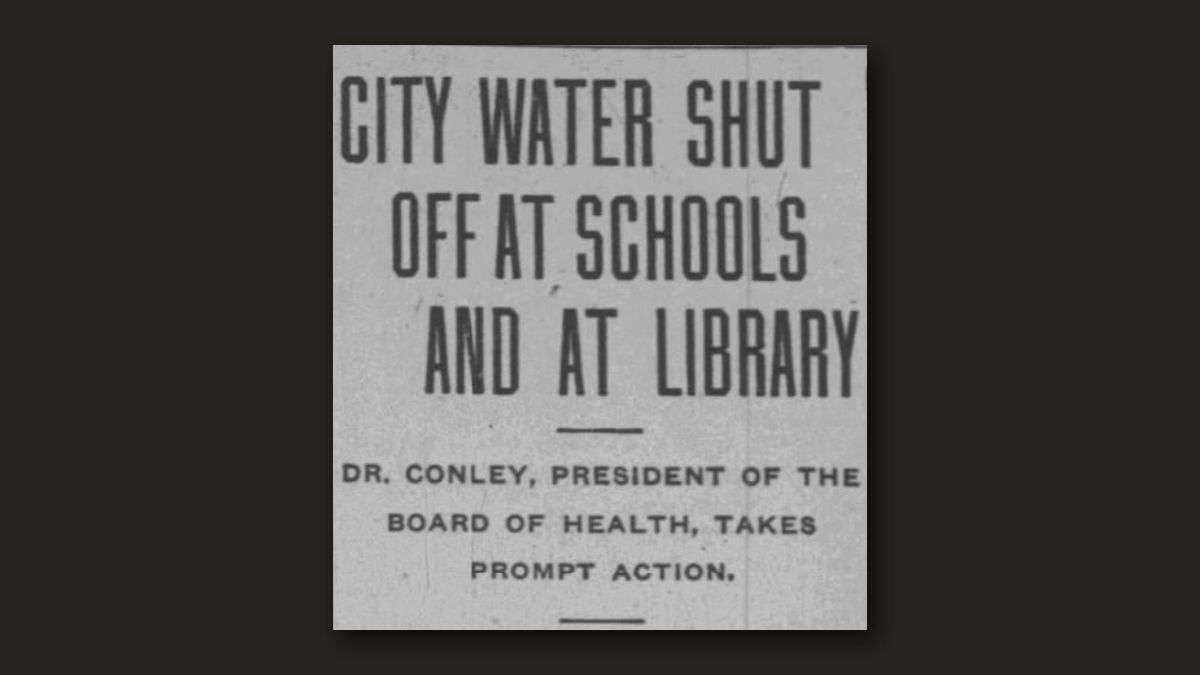
On Feb. 11 and 12, health officials ordered drinking water shut off at Streator's public schools, the library and every public drinking fountain.
At the high school, cups were taken from the faucets, and students could drink only boiled water. "Boiled water is the delectable drink at the noonday luncheon," the Free Press reported, served under the direction of the domestic science department.
The warning extended beyond public buildings.
Residents were told that neither the Aqueduct Co.'s water nor water from private wells should be consumed without first being boiled.
A Free Press reporter caught up with the water company's superintendent, Huggans, and asked whether the water had been shut off at the schools.
"I don't know," Huggans said. "You'll have to see Dr. Conley, president of the board of health. He is the man to take such action, if anybody does."
Then he added, "I presume the water ought to be shut off. I would have done it before now if I had been guarding the city's health."
Further than that, the paper said, he declined to talk.
The same story offered some comfort. No new cases had developed in the past 48 hours, the paper said, and "if citizens use proper precaution there need be no alarm."
The hospital, though, was crowded. For the first time in its history, a trained nurse from Chicago was there, in charge of a very sick patient. The paper said "the sixteen sisters" at the hospital were being kept busy.
On Feb. 13, the Streator Medical Association met to discuss the outbreak. So many physicians were busy with patients that attendance was light.
Those who came agreed almost without exception that "the water, more than the milk or food supply, was the foundation for many cases of typhoid." It was not safe, they said, to drink any water that had not been boiled.
The deaths continued.
Sadie Abrams, 18, died at the hospital at 7 o'clock on the morning of Feb. 14. She was one of 10 children, born and raised in Streator, and had graduated from the high school the year before.
She had taken a job teaching at the Prairie Center school north of Ottawa. After three months, illness forced her to stop. Her family stayed with her constantly through her last day.
Three days later, 7-year-old John Gdovin of Cable Street died after two weeks of typhoid.
On Feb. 20, Edith Jarmain, 14, of North Bloomington Street, died after four weeks in bed. The paper remembered her as "an ambitious pupil at school."
Two days later, Mabel Fraser was dead. Ten days had passed since the paper said there need be no alarm.
How many were sick?
Even as the deaths mounted, city officials struggled to say how many residents had the disease.
When Conley's delayed January report finally reached the council Feb. 18, it showed 33 deaths from all causes within city limits that month, compared with 22 in December.
Three of the January deaths, he reported, were caused by typhoid.
But Conley could not provide a reliable count of the sick. Physicians were not required to report typhoid cases to the health department.
After talking with local doctors, he estimated that fewer than 30 people had the disease.
That estimate was hard to square with the newspaper's growing list of patients. By the end of February, the Free Press had reported roughly two dozen people by name, and new cases were still appearing.
The city was confronting a disease it could not reliably count.
The verdict
The bacteriologist who inspected Streator's waterworks on the day Mabel Fraser died was Dr. Adolph Gehrmann of Chicago.
His report, dated Feb. 27, reached the City Council on March 4.
He found that the January flood had partly swamped the pumping station. There was, he wrote, "every evidence that the Vermillion river water had gained access without adequate treatment to the city mains."
His conclusion was unmistakable.
"The cause of increased typhoid in Streator," Gehrmann wrote, "is due to contamination of the water supply."
Upstream, Pontiac's sewers emptied into the Vermilion. Gehrmann did not trace exactly where the contamination came from, but he concluded that river water had reached Streator's taps without being made safe.
He also tested milk from five local sellers. None of the samples showed the typhoid germ, although he found one milk depot in a dilapidated frame building where a family lived in the back.
Gehrmann recommended continued public warnings, boiled drinking water, shutting off the water at the schools, testing the water until it returned to normal and licensing milk sellers.
Another report, from the University of Illinois, was read at the same meeting. It found the water was still contaminated and should be boiled before drinking.
The council agreed to have it tested twice a month.
While the aldermen were hearing those findings, another Streator family was mourning.
Make Gaydos, a 38-year-old coal miner born in Austria-Hungary, died at St. Mary's Hospital on March 4 after about a week of illness.
He had lived in Streator for about 12 years.
Living with it
Finding the cause did not solve the problem.
Residents still had to boil their water. Families kept caring for the sick, and businesses found ways to work around the uncertainty.
The weekly Free Press ran a story about the milk investigation under the headline "Germs Are Scarce." It reported that the milk had not been implicated in the outbreak, without discussing Gehrmann's findings about the water.
Local dairies began advertising their clean test results.
At City Hall, the argument turned partly to money.
On March 18, aldermen received Gehrmann's bill for $92.50.
They called it a "holdup," argued that $50 a day was the customary rate for such work and sent the bill back.
The newspaper described the expense as payment for "finding no germs in six bottles of milk," although Gehrmann's work had also identified the cause of the outbreak.
At the same meeting, Alderman Casey complained that the water company still had not kept its promise to flush the city's mains "and drive the barnyard bacilli from the pipes."
And people were still dying.
Russell Wilkins, a 24-year-old clothing salesman, had kept working at the store for more than a week, complaining that he did not feel well but "not realizing that the ailment would develop into anything serious." He died at the hospital March 17.
Luke McCumpsey, 49, a gasmaker at the bottle works, died March 21 after five weeks of typhoid fever. He left his wife, Sophia, and six children.
On March 28, John Pritts, a 31-year-old driver who had lived in Streator for 12 years, died at his brother's home on South Park Street after 21 days of typhoid.
The city went on with its business.
That spring's mayoral election centered on whether Streator's saloons should close on Sundays. The water trouble was hardly absent from public life, but it did not become the campaign's defining issue.
At an April 9 meeting about Sunday closing, Mayor P. J. Lucey told the crowd, "You don't pay taxes enough to pay for the water, bad as it is."
He lost the election by 36 votes.
A few days later, a Streator grocer advertised grape juice as something people could drink "while the water is poor."
There were signs the worst had passed. On April 1, Conley reported that the epidemic had "nearly spent its force," with only a few cases remaining.
But he also complained that the water should have been tested again by then, so residents could know when it was safe to stop boiling it.
Spring was coming, he wrote, and "it is a great hardship to boil the water without plenty of ice for cooling."
The outgoing City Council passed a milk-licensing ordinance in early May, one of Gehrmann's recommendations.
"Take Good Drink"
The Aqueduct Co. flushed the water mains in early April, but the state's next test still said to keep boiling.
Then, on June 10, 1907, the Free Press delivered the news Streator had been waiting months to hear.
"City Water Safe; Take Good Drink," the headline announced.
State chemist Edward Bartow had examined the supply again. The muddy water had cleared.
"The water is safe to be used for drinking purposes at the present time," he reported.
Health Officer James Jones ordered the water turned back on at the schools, the library and the public drinking places. It would run from all pipes day and night, the paper said, and people could drink from the public fountains the next day.
The story ended with a line of its own. "Have one on the water company."
For the first time in about four months, residents no longer had to treat every glass of city water as a possible danger.
What came after
In 1907, the Aqueduct Co. relied on settling and sand filters to make river water fit to drink. The system could remove mud and many microorganisms, but it lacked a separate disinfection step to kill disease-causing bacteria.
The company rebuilt its filters the following year. In December 1908, it bought a full page in the Free Press promising "an abundance of pure, clean and fresh water to the city at all times."
The page did not mention the typhoid outbreak.
Within a few years, the company began disinfecting its water with chlorine. By November 1913, state inspectors documented the use of hypochlorite as part of the treatment process. The waterworks also had a laboratory, and the results of daily bacterial testing were being published in local newspapers.
A promotional history of Streator published in 1912 acknowledged how exposed the earlier system had been.
Before chlorine, the book said, "there was always the haunting fear that some typhoid germ or colon bacillus would get by."
The quality of Streator's water had long been "one of its tenderest points," the book admitted, "one dangerous to discuss before strangers."
It never mentioned the 1907 epidemic by name.
Streator still draws its drinking water from the Vermilion River. The system, now run by Illinois American Water, filters it, disinfects it and treats it with ultraviolet light before it reaches customers.
In 1907, all anyone could do was boil it and wait.
We dig into Streator history using the original newspapers and records. If you want more stories like this one, sign up for our free newsletter and we'll send them to your inbox.
Sources: The Streator Daily Free Press, 1883 to 1908, via Newspapers.com; Illinois State Water Survey reports; "The Story of Streator" (1912); "Forty Gavels," a biography of Reuben G. Soderstrom.