How Streator Lost Its Streetcars
The cars tied downtown to Streator's neighborhoods and factories. By 1924, even the local paper wanted them gone.
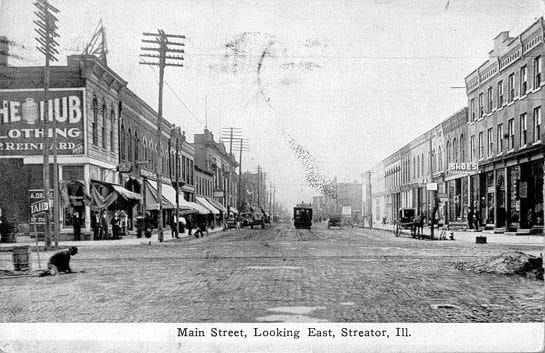
STREATOR — For a nickel, Streator residents could board a yellow streetcar on North Bloomington Street, ride through downtown on tracks laid down the middle of Main Street and continue toward the city's neighborhoods and factories.
The system opened in 1890. It survived a carbarn fire, receivership and nearly five years without service before its last cars ran at noon Oct. 21, 1924.
Main Street carried the system's only double track, according to a history of the line by Stephen Scalzo published on the Hicks Car Works blog of the Illinois Railway Museum.
The first ride
It started a little after 2 p.m. on Oct. 9, 1890, when two new streetcars left the company powerhouse on Sterling Street carrying Mayor Geraghty, city officials, newspaper editors and local businessmen. The cars ran south on Sterling to the Wabash crossing on Illinois Street, then north to the end of the track at the section line on Bloomington Street, where the riders stepped off for speeches, according to the Streator Free Press of Oct. 10, 1890.
Streator was among the early towns to run electric cars. In 1890 only about 15% of street railway track in the United States was electric, according to the 1902 federal census of street railways. By 1902 the figure was 97%.
Before the streetcars, horse-drawn buses ran only between the railroad depots and the hotels, and horse-drawn hacks carried passengers for hire, according to "Biography in Black," the 1962 history of Streator.
Yellow cars and copper tokens
The first six cars arrived on the Santa Fe railroad. Each was 23 feet long, painted yellow with a green band. The company had eight by the end of October 1890.
The fare was a nickel. Riders paid with copper tokens about the size of a cent, each with a square hole and stamped "Streator Railway Company, one fare," with a streetcar on the back.
The first line ran north and south through downtown, from Illinois Street at the Wabash tracks up North Bloomington Street. A South Bloomington line followed in November 1890. The Streator Railway Co. had been organized in December 1888 with $250,000 in capital, and the city granted its franchise in January 1890. Streator had 11,414 residents that year.
A system that rarely paid
The streetcars struggled financially almost from the beginning. The carbarn burned in February 1891, stopping service for weeks. The company was profitable in only two of its first six years. Service halted in November 1896 when the company went into receivership, and in October 1898 the system was sold to C.C. Barr for $14,000.
It was the same Barr who founded the Barr Clay Co., maker of Barr bricks. A bridge-building contractor, he first came to Streator because of his street railway interests, as the company's heaviest stockholder, according to a Free Press industrial review published Feb. 13, 1902. Looking over the area, he saw the value of the local clay and moved his business here, the paper reported.
The cars sat idle for nearly five years. When service resumed Aug. 26, 1901, under the People's Light & Railway Co., a crowd of boys followed the first car down the street, and some were finally allowed to ride to the end of the line, the Free Press reported. Horses shied along the route. The company hired nine Streator men as motormen and conductors.
The system changed owners six times between 1890 and 1924. At its largest, in 1911, it had 10.5 miles of track and 16 cars.
Who rode, and where
The lines were laid out around where people lived, worked and spent their time off.
Every line passed through downtown. Shoppers could ride to Main Street stores from the north and south ends of town without a horse or, later, an automobile.
The tracks also followed the factories. When service resumed in 1901, the company planned a branch toward Painter's Addition, northeast of downtown. In September 1909, a 1-mile extension carried the South Illinois Street line south from the Wabash tracks toward factories near the county line, including the sewer pipe works and Barr's brick works.
The factory owners paid for it. At a City Council meeting that month, real estate man J.C. Barlow said he, Barr and other men with interests in plants on or beyond the county line had persuaded the Illinois Light and Traction Co. to build the extension. The manufacturers advanced the company $5,000 and took the same amount in ride tickets, planning to pass them along "to employes or others who might desire transportation," the Free Press reported Sept. 21, 1909. Barlow said the Metal Stamping Works there employed 150 people and the Streator Motor Car Co. expected to employ 250 to 275 that winter.
The cars also carried people to their leisure. The line served Electric Park, a dance hall and concession grounds on Bloomington Street. After a tornado struck Streator in June 1903 and destroyed the park, the cars carried more than 7,000 sightseers a day for two days, according to "Biography in Black."
In 1908 the Chicago, Ottawa & Peoria interurban reached Streator. It was a separate electric railway linking Streator with Ottawa and other Illinois Valley cities, with a car to Ottawa every two hours. In the 1920s, Streator residents rode it to dances at Illini Beach, south of Ottawa, according to "Biography in Black."
Costs rise, riders drive
Prices nationally roughly doubled between 1914 and 1920, according to federal consumer price data, while streetcar fares across the country were held at a nickel by local franchises. A federal commission reported in 1920 that the electric railway industry had lost its financial credit, blaming the 5-cent fare along with labor and material costs.
Small-city systems across Illinois faced the same squeeze. Pontiac's streetcars ended in 1925, LaSalle-Peru's in 1926, Kankakee's and Galesburg's in 1931 and Ottawa's in 1934.
In January 1921 the Streator company asked state regulators for a 10-cent fare. It received 8 cents for adults and 4 cents for children ages 5 to 12, the Free Press reported Jan. 10, 1921.
At the same time, automobiles were spreading. The number of motor vehicles registered in the United States rose from about 468,500 in 1910 to 20.1 million in 1925, according to the Federal Highway Administration. Illinois voters approved a hard-roads bond issue in November 1918, and the original State Bond Issue Route 23 ran from the Wisconsin line to Streator by way of DeKalb and Ottawa.
By 1923 the Free Press had given up on the cars. A Nov. 6 editorial said the schedule was "so far apart that it is possible to walk as quickly as it is to catch a car." It urged the city to let the tracks be torn up for motor buses that could cover the districts already served and reach others. The only argument for keeping the cars, the paper wrote, was pride, "false pride probably," adding, "Street car service isn't worth anything unless there is service."
A week later the City Council voted 4-1 to let the company quit, with Commissioner Elias opposed, the paper reported Nov. 14, 1923.
The state approves
The company petitioned the Illinois Commerce Commission in 1924 to abandon service and warned it would go bankrupt if the request were denied, the Free Press reported July 24, 1924. The paper said local opinion had been divided when the idea was first raised, and the city attorney appeared at the state hearing to require the company to prove its case.
Two years earlier, in a case involving Ottawa's streetcar company, the Illinois Supreme Court had ruled that a utility earning a fair return on its whole system could be required to keep running unprofitable lines.
The commission approved Streator's abandonment July 30, 1924, finding that the system had lost money for years. The same decision granted a certificate to the Yellow Bus Co., operated by Chas. Cates, to run replacement buses. The bus company's permit depended on the streetcars being allowed to stop, the Free Press reported Aug. 4, 1924.
The last day
"Time is short for a farewell ride on the city street cars," the Free Press told readers on its front page Oct. 20, 1924. W.C. Dowdy, the Public Service Co. superintendent, set the last run for noon the next day, provided the new buses kept their schedule. He would make sure people had transportation, the paper said, "before the cars are run into the barns for keeps."
Two lines remained at the end. One looped from North Bloomington Street through Hickory, Sterling and Main streets. The other ran from 12th and Bloomington streets through downtown to South Illinois Street. Three buses replaced them, running every 20 minutes over what the paper called practically the same territory.
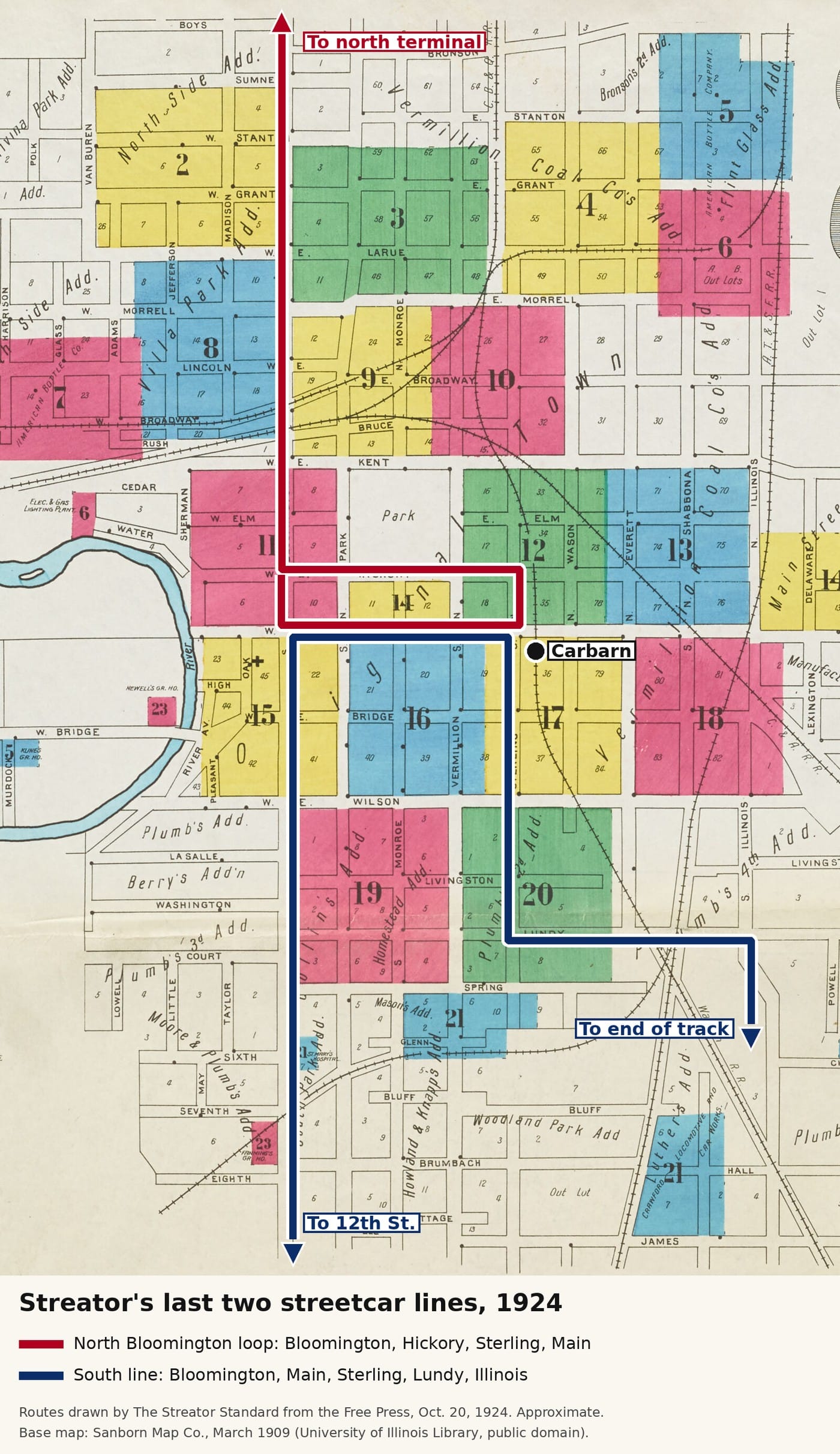
The fare on the last day was 8 cents for adults and 4 cents for children, with free transfers.
The company planned to move the carmen to other jobs within the Public Service Co. The cars were expected to be junked. Trolley wire and poles would come down once the buses proved themselves.
On Oct. 21, 1924, the day service ended, page 4 of the Free Press carried a large Buick advertisement for motor cars. The separate interurban line to Ottawa kept running until 1928.
The rails did not stay long. A month after the last run, crews had pulled the track from North Bloomington Street as far north as Boys Street, Dowdy told the City Council, the Free Press reported Nov. 25, 1924. In May 1925, Mayor S.I. Myer's annual report counted the removal of almost the entire streetcar track system among the city's improvements of the year.
That same week, repaving crews on the first block of East Main Street found a hole about 4 feet deep and 5 feet long under the old ties they were pulling out. A broken water main had washed it out, the Free Press reported May 7, 1925. Many believed the hole had been there for weeks, the paper said, and that the streetcar ties were all that had kept traffic from crashing through the pavement.
Sources: The Streator Daily Free Press, 1890 to 1928, via Newspapers.com; "Biography in Black" (1962) by Paula Angle, based on Ted Weber's historical radio series; "Streetcars in Streator" and "Chicago Ottawa & Peoria" by Stephen Scalzo, Hicks Car Works blog; U.S. Census Bureau, "Street and Electric Railways, 1902"; Federal Highway Administration; Northern Illinois Light & Traction Co. v. Commerce Commission (Ill. 1922).