The Day Streator’s Police Helped Rob the Bank
Six gunmen, $52,000 (more than $1 million today), and a police station on the same block. And that was just the first morning.
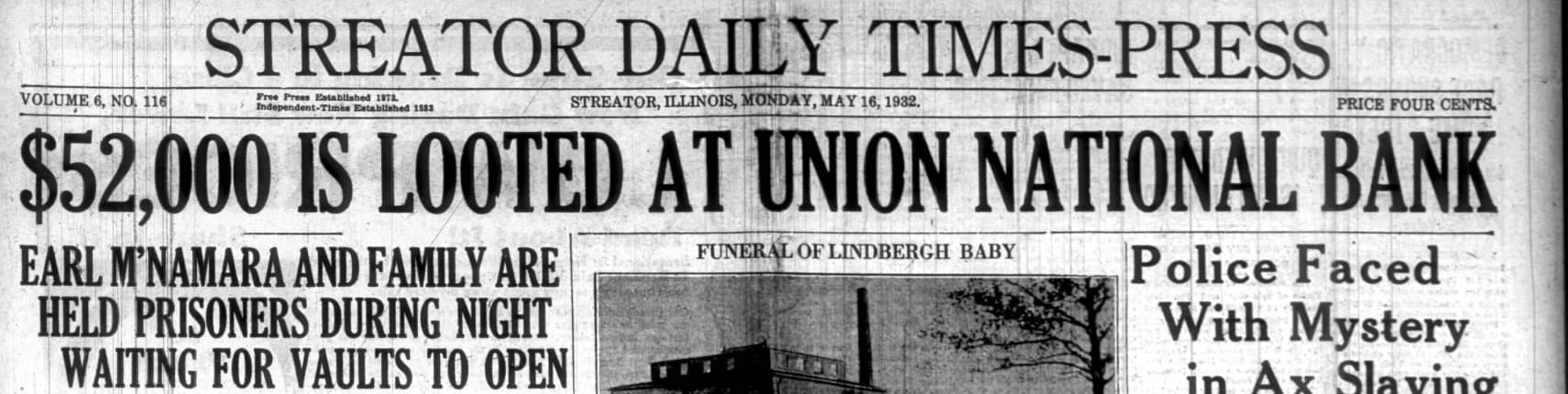
At 7:45 on a Monday morning, Earl McNamara was taken from his home at gunpoint and escorted to the bank where he worked.
Another armed man stayed behind with his family.
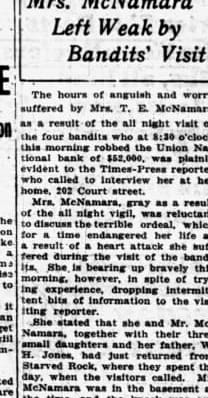
For hours, gunmen had held the McNamaras prisoner inside their house on Court Street. His three children, his wife and her elderly father remained there. During the night, his wife had suffered what the newspaper would describe as a heart attack, serious enough to endanger her life.
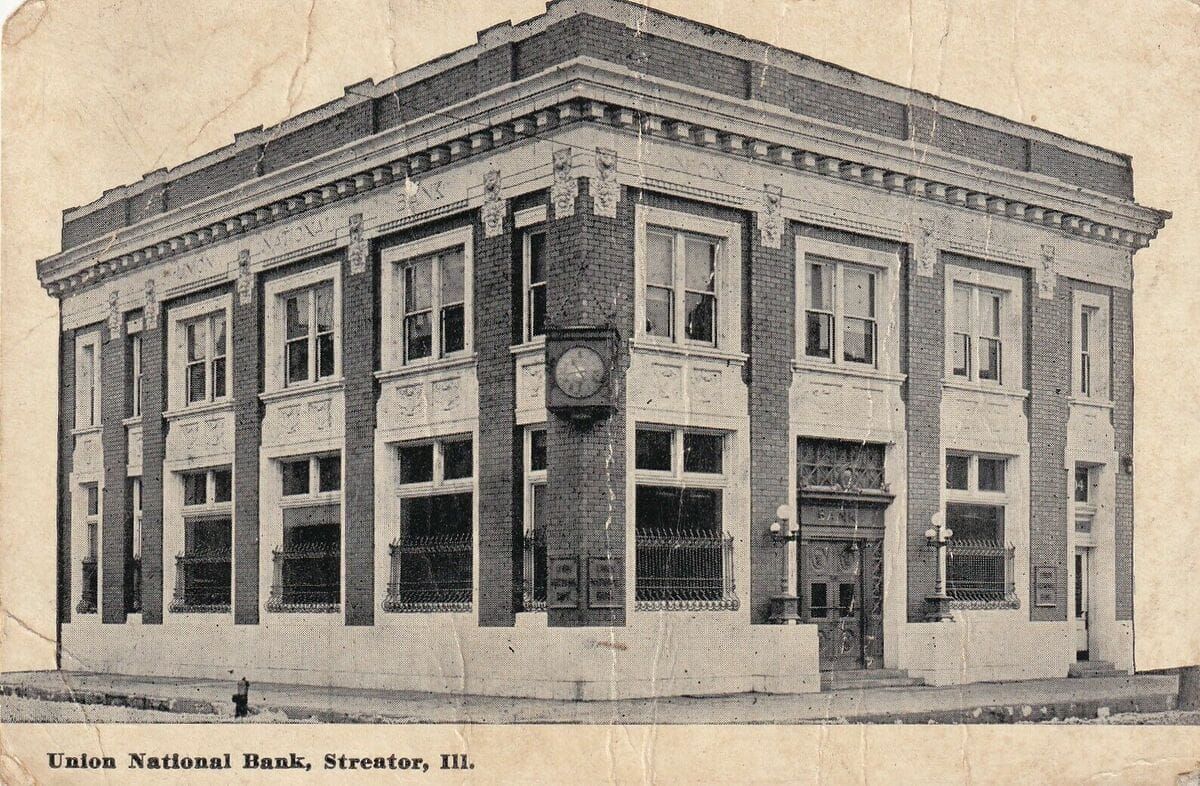
Now the gunmen were taking McNamara to Union National Bank, where he served as assistant cashier.
His colleagues would soon arrive for work. The robbers planned to be waiting inside.
It was May 16, 1932. About $52,000 sat inside the vault—roughly $1.2 million today.
The gunmen had McNamara. They had his family.
But the vault had a time lock.
It wouldn’t open until 8:20.
So they waited.
They had been here before. On an earlier morning the gang had come to rob the bank and called it off, because the janitor was late.
This time, everything was on schedule.
The armed men had entered the McNamara household the night before, covering their faces with handkerchiefs.
One of them, a Chicago gunman named Al Brown, later described the entry.
“Chuck walked in to the front door and Ike and Frank walked to the back door. I stayed in the car till they got in the house and then walked in the front door.”
Chuck was Charles Tilden. Ike was Louis Katzowitz. Accounts differ on whether five or six men came that night.
Around three in the morning, two left. When McNamara was taken downtown, Brown remained behind to guard the family and wait for a telephone call.
At the bank, the gunmen took hostages. Each person coming to work that morning entered a building that was controlled by armed men.
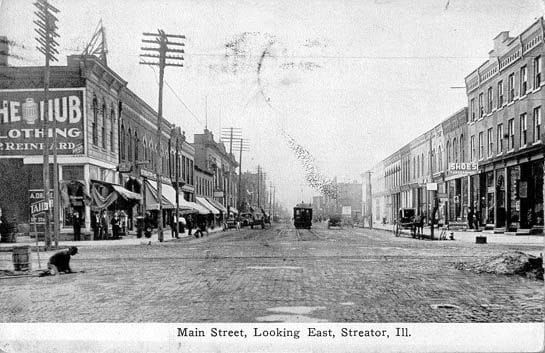
Outside the bank, a Streator patrolman named George Kmetz was working in the 100 block of East Main Street. By his later account, he passed the bank corner two or three times that morning.
Inside, the robbers waited for the vault to unlock at 8:20.
And then someone, somewhere, made a telephone call.
According to a wire account published in the Cincinnati Enquirer, the caller reported a “bad accident.”
At 8:14, the police, who had been in the station on the same block as the bank, left to investigate an accident elsewhere in town.
At 8:20, the robbers took the money.
At about 8:30, the telephone rang at the McNamara house.
Brown received the message he had been waiting for.
“Everything is OK.”
Brown walked out of the house. After a night under guard, the McNamaras were alone—and free.
Police found a stolen Plymouth sedan abandoned on a rural road northeast of town.
The men had apparently changed cars.
Brown went to the home of Joseph “Steamboat” Cosmano, a Streator man. The others arrived in a Dodge, he said, and the money was divided there.
“They had $50,000. Of this $14,000 or $15,000 was in gold.”
Brown received $4,500, including $1,500 in gold.
Back downtown, the bank arranged to replace the stolen funds. Its loss was insured. Replacement money arrived at noon.
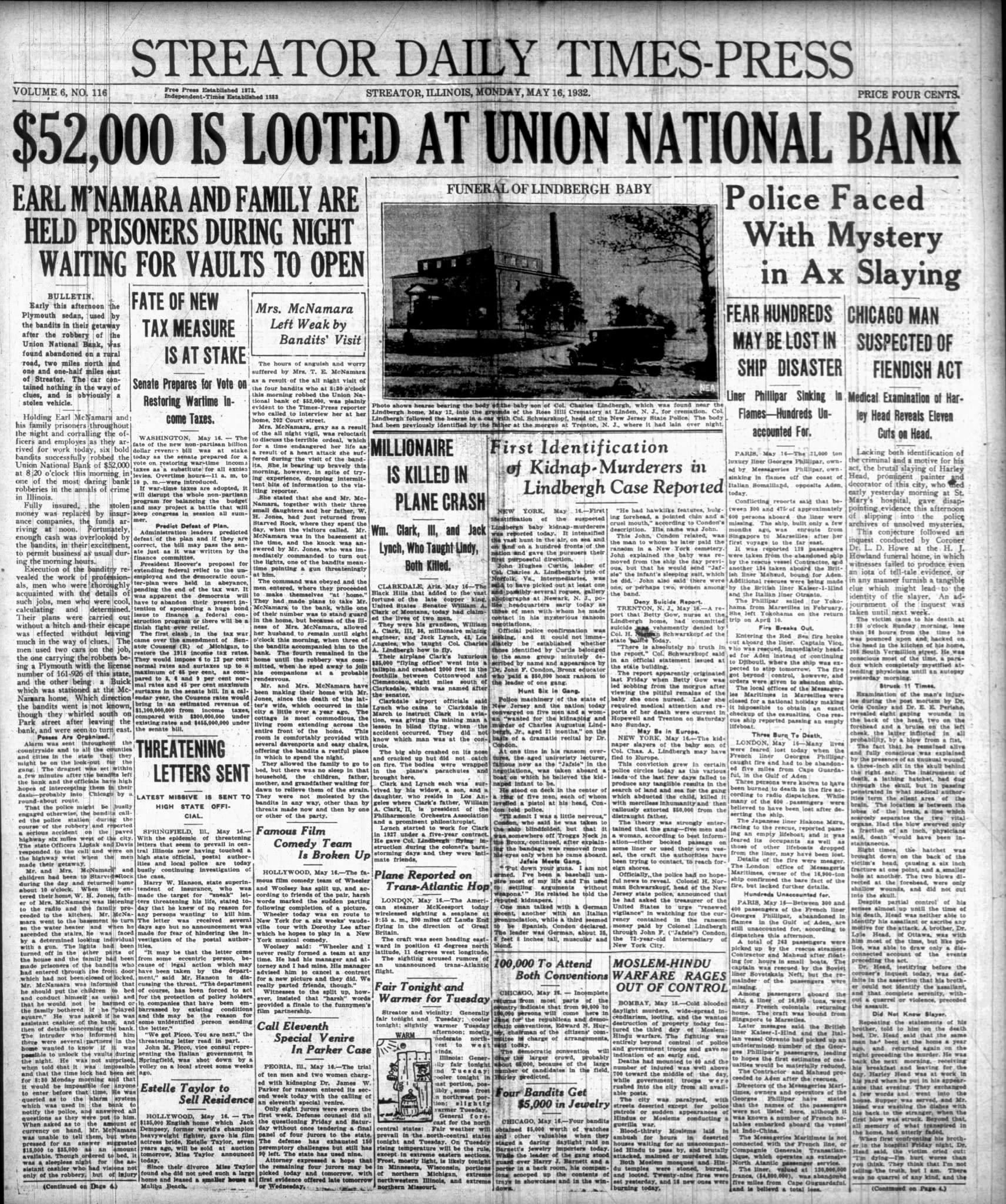
The Times-Press spread the robbery across its front page. The gang had known the bank’s routine, the time lock, the hour the staff arrived. How they had learned all that was a question investigators could not yet answer.
They also had to find the men.
Mayor George Elias had already been pressing his assistant police chief, Clarence Goss, to solve the robberies and holdups troubling Streator. He had urged Goss to “expend every energy possible.”
The following day, outside help arrived to aid the investigation.
A. R. Lapitz, a Burns Agency detective assigned by the American Bankers’ Association, came to Streator.
Goss approached Burns and the two men discussed the case.
The Times-Press later described that encounter as the point at which the story began to unravel.
Goss would later give his own account of why he had sought out the detective. He had met with the gang, he said, only to round them up.
McNamara, the bank employee held hostage with his family was subsequently interviewed again.
LaSalle County Sheriff E. J. Welter was brought in to assist, and soon, authorities began rounding up suspects.
On May 22 and 23, officers began making arrests in Chicago.
They arrested Brown.
They arrested Katzowitz, recovering $3,500 from his safety-deposit box.
In Streator, they arrested Cosmano and Frank Cingrani, two local men accused of helping arrange the job.
Then the investigation reached the police department.
Clarence Goss, the assistant chief of police, was arrested.
So was Kmetz—the patrolman who had passed the bank corner that morning.
On May 24, the Times-Press published their confessions.
Both men had known about the robbery before it happened.
Both had been promised $5,000.
A week before the gunmen entered the McNamara house, Goss had met Cingrani and Cosmano in a car outside the Santa Fe Hotel.
His statement described a conversation that took place on a road near a cemetery west of town.
“It was understood I was to be taken care of.”
The assistant police chief whom the mayor had urged to solve the city’s robberies had agreed to receive money from this one.
Goss claimed he had been asleep in bed when the bank was robbed and had gone straight to the station afterward.
Kmetz’s account placed him much closer.
He had been on East Main Street. He had passed the bank corner. When the robbery occurred, he said, he was attending to a man at a bus.
“I did not tell the chief of police what I knew.”
About three nights before the robbery, someone had telephoned Kmetz at home. Keep quiet, the caller warned, or be “put on the spot”—killed, in the slang of the day.
After the robbery, Goss told him he had a share coming. Kmetz believed Cingrani had the money hidden.
He made no arrest.
“I was scared of getting knocked off.”
The newspaper reported that Goss wept as he confessed.
Neither officer had received a cent.
The confessions also answered the question of how the gang had known the bank so well. The knowledge had come from the town. Cingrani and Cosmano had scouted the job. And two men on the Streator police force had known for a week that it was coming.
“It doesn’t seem possible,” Mayor Elias said.
The money was causing trouble elsewhere, and the story was far from over.
According to the Times-Press, the Chicago gunmen forced Cingrani and Cosmano to surrender another $10,000. Cingrani was taken from his house at night, driven to Joliet and returned around four in the morning.
He later described the trip as “a party with some friends.”
Investigators searched homes from cellar to roof. Welter and other officers pursued the remaining suspects across state lines.
On May 30, Welter arrested Tilden in Minneapolis.
On June 10, Jacob Pearson was arrested in Boston.
Welter returned to Ottawa with Pearson on June 14 and placed him in the La Salle County Jail. Katzowitz and Tilden were already there.
Each of the three was held under $100,000 bond.
The sheriff had his prisoners.
But the following afternoon was visiting day.
At about 2:30 on Wednesday, June 15, five men entered the jail.
They came separately, mingling with the visitors gathered inside.
One asked for Pearson, the prisoner brought back from Boston only the day before. Jailer George Mosley had him brought down to the bull pen.
Then Mosley headed toward the kitchen.
“I felt a gun pressed against my back,” he later told the Times-Press.
Mosley turned and pushed the gunman away.
Another man stepped up with a second gun.
The jailer was overpowered.
Accounts differed on precisely how the keys changed hands. The Chicago Tribune reported that a raider passed a revolver through the bars to Katzowitz, who forced the prisoner assisting Mosley to surrender them.
Katzowitz ran upstairs and freed Tilden and Pearson.
Outside, cars waited.
The jailer was locked up. The three prisoners joined the men who had come for them and left.
Brown remained in his cell. Left behind because his confession had helped expose the robbery.
Goss and Kmetz were left behind, too.
Then a prisoner rushed from the corridor into the office and reached the telephone.
It was Goss.
The former assistant police chief called the sheriff’s office to report the escape.
Welter and his deputies were across the way in the courthouse. The sheriff began organizing a posse.
The men he had brought in from Chicago, Minneapolis and Boston were free and back on the road.
On July 6, Goss and Kmetz stood before Judge Edgar Eldredge.
Both pleaded guilty to robbery.
Both received sentences of one to twenty years at Joliet.
The Times-Press described them standing with lowered heads as the sentences were pronounced. Neither commented.
Other prosecutions followed. Local conspirators were convicted or pleaded guilty.
But the three men freed from the county jail remained at large.
Summer passed. Then autumn. Then winter.
The first anniversary of the robbery came and went.
That December, Chicago police began a new hunt.
Their target was John Dillinger.
On December 14, 1933, Dillinger gang member John Hamilton killed Chicago police sergeant William Shanley.
Two days later, the department formed a forty-man squad under Captain John Stege to hunt Dillinger and his associates.
On the night of December 21, a tip brought officers to an apartment at 1428 Farwell Avenue in Rogers Park.
They believed Dillinger was inside.
Twenty policemen surrounded the building, armed with machine guns. Sergeant Frank Reynolds led a smaller group to the front door and rang the bell.
The door opened a few inches.
According to contemporary newspaper accounts, Reynolds demanded surrender and was answered by gunfire.
He threw his weight against the door and fired. The man in the front room was struck in the head.
Two others barricaded themselves in another room, firing revolvers. One was killed there. The last retreated into the kitchen, where he was cornered and shot dead.
No policeman was injured.
For nearly three hours afterward, police believed they had killed Dillinger and two of his associates.
Then the fingerprints came back.
One of the dead was Sam Ginsburg, a Chicago ex-convict who was not implicated in the Streator robbery.
The other two were Katzowitz and Tilden.
Welter went to Chicago and identified their bodies.
That same night, a jury in Ottawa was deciding the fate of another man charged in the Union National robbery.
Frank Zimmerman was a Chicago cab driver accused of being one of the gunmen. He had presented eleven character witnesses, a physician’s alibi for the morning of the crime and his own account of his travels.
The jury received the case at 6:15 p.m. on December 21.
While police surrounded the Farwell Avenue apartment, the jurors deliberated.
By noon the next day, they still had no verdict.
At 1:20 p.m., they returned.
Guilty.
Zimmerman received a sentence of one year to life.
The Times-Press placed his conviction beside the deaths of his alleged confederates: two men in the Chicago morgue, another bound for prison.
Pearson was still free.
On March 20, 1934, Welter and Chicago detectives arrived at an apartment at 5044 West Washington Boulevard.
With them was Sergeant Frank Reynolds, who had forced his way through the Farwell Avenue door three months earlier.
This door was opened by a man identified as Pearson’s brother-in-law.
The Times-Press reported that the officers found Pearson asleep.
Two loaded revolvers were under his pillow.
There was no gun battle.
At the detective bureau, Pearson snarled at photographers and pulled his hat over his eyes. The following day, he pleaded guilty to participating in the Streator robbery.
He received a sentence of one to twenty years and was taken to Joliet.
Nearly two years after the gunmen entered the McNamara house, the newspaper declared the gang accounted for.
Investigators had recovered $14,000 of the approximately $52,000 stolen.
The remaining $38,000 was never found.
Afterward
Earl McNamara returned to work. In 1933, he became the bank’s cashier.
Union National continued through later decades under a succession of names.
The bank building at 200 E. Main St. is today Gaetano’s Vault, a restaurant and bar. The restaurant tells its own version of the robbery, one involving Al Capone’s gunman “Machine Gun” Jack McGurn and members of the Dillinger gang, caught before they could leave town. The newspapers of 1932 tell the story above.
Goss and Kmetz did not leave Joliet together. Kmetz was paroled on July 20, 1936, the same day as “Steamboat” Cosmano, a little less than four years after the two were taken to prison. He went to work in a factory. He died at his home on East Wilson Street on August 23, 1952, at 59, and was buried from St. Anthony’s. He left a widow and five children.
Goss stayed. The parole board turned him down in 1935 and again that summer. In November 1940, six people went before the board to ask for his release: his wife, two sisters, a brother-in-law and two friends. One of the friends was George Elias, the mayor who had said in 1932 that it didn’t seem possible. Goss was freed in March 1941, after more than eight years. By 1950 he was a widower, working as a foreman in a bottle-glass mold shop.
The gunmen came home around the same time. Abe Krotish, who had bought a candy store in Newark with his share, was paroled in April 1941. Frank Cingrani and Frank Zimmerman were paroled that October. Al Brown, whose confession broke the case, never went to prison.
The robbery’s one real link to John Dillinger ran through Zimmerman’s trial. The Chicago physician who gave Zimmerman his alibi, Dr. Harold B. Cassidy, was indicted for perjury in Ottawa three weeks after the verdict and disappeared. In August 1934, federal agents arrested him in Chicago with Dillinger’s lawyer and another doctor, charged with altering Dillinger’s face and fingerprints. The Times-Press put it on the front page: “Dr. Cassidy Nabbed for Dillinger Operation — La Salle Co. Fugitive Is Held by U.S.”
Editor | Streator History
Sources: Streator Daily Times-Press, May 16 and 24, June 15–16 and July 6, 1932; December 22–23, 1933; March 20, 1934. Chicago Tribune, June 16, 1932, and December 22, 1933. The Pantagraph, December 22, 1933. Cincinnati Enquirer, May 17, 1932, wire account for the police diversion call. Jacksonville Journal Courier, March 22, 1934, Associated Press account of Pearson’s plea and sentence. Streator Daily Times-Press, January 21, 1935; November 25, 1940; October 20, 1941; December 7, 1959. Morris Herald-News, July 16, 1935. Streator Daily Times-Press, January 12 and September 1, 1934; August 23, 1952. Ottawa Daily Republican-Times, November 7 and 13, 1934; July 21, 1936; November 25, 1940; March 24, 1941; April 7 and October 7, 1941. The Pantagraph, June 13, 1942. 1950 U.S. census.