The Shallow Grave on South Bloomington Street
The dining room table in the Hill family home on South Bloomington Street was set for two, but the woman of the house was under the basement floor.
That is where the story of Harry Hill begins to sink into Streator history. Not in a dark alley. Not along a lonely road. Not with a stranger passing through town. It begins inside a prominent local home, with a respected family name, a worried father, a missing mother, a disturbed patch of basement earth, and a young man who would spend the next several years living between suspicion and freedom.
In August 1927, Streator was not yet the old town we sometimes picture in sepia. It was alive, industrial, argumentative and full of the usual ambitions and troubles of a place that had already seen coal, glass, money, migration, pride and disappointment pass through its streets. The city had newspapers. It had gossip. It had class divisions, pool rooms, churches, family reputations and people who knew just enough about one another to be dangerous.
Then came the Hill case.
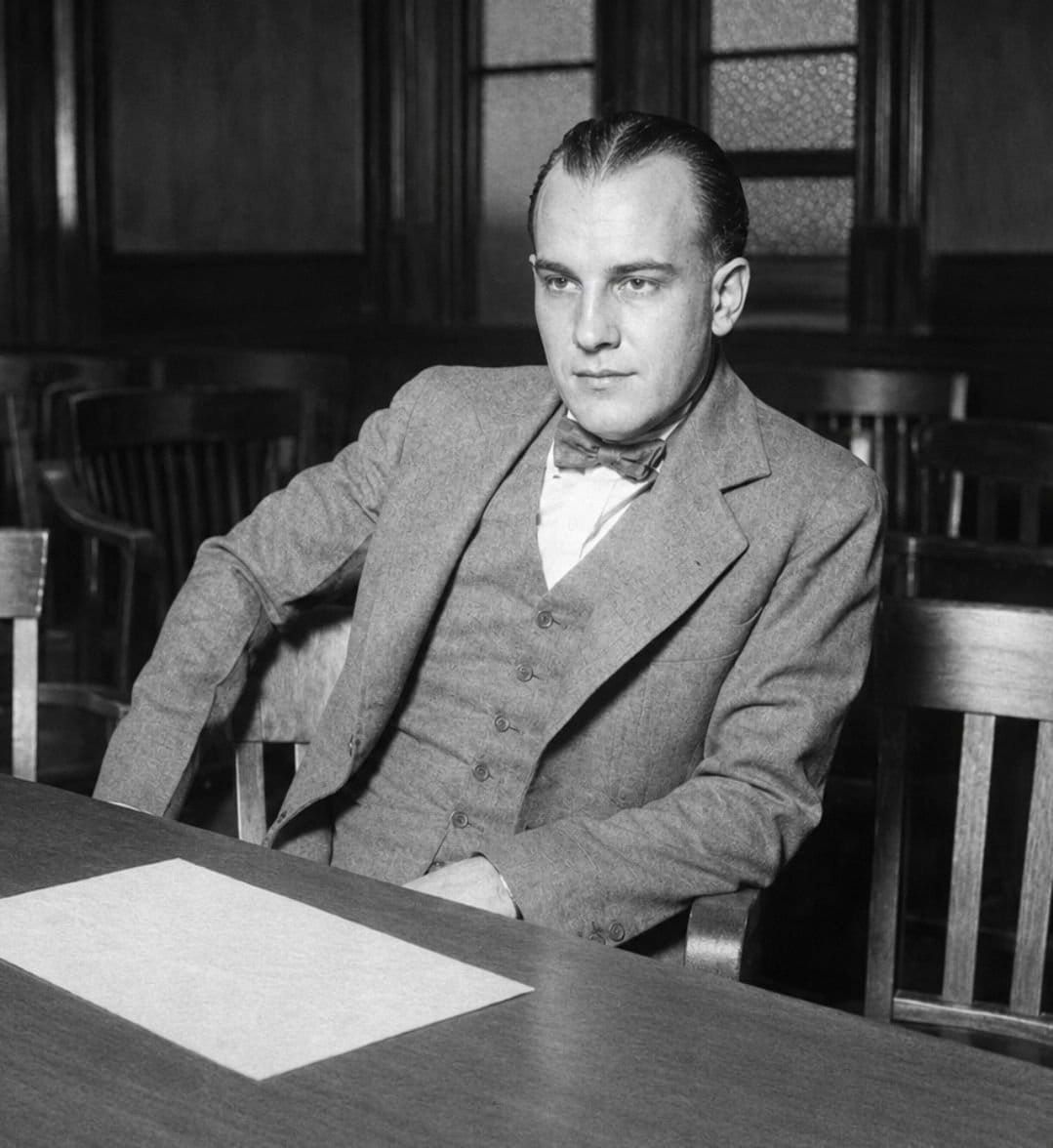
Harry Hill was young, well known and, by many accounts, likable. He was the son of Dr. H.C. Hill, a Streator physician. Harry had been a cheerleader in high school, which is the kind of detail that seems almost too ordinary for a murder story until it becomes exactly the point. People who end up at the center of terrible stories are almost never monsters in everyone’s memory. They are sons, classmates, customers, charmers, disappointments, familiar faces.
That is part of what made the case so unsettling.
The trouble appears to have started with a check. Dr. Hill came into possession of a check for more than $1,000 made out to Harry and signed by Mrs. Hill. According to the later account in Biography in Black, the doctor knew Harry had sometimes forged checks when he needed money, and he decided to speak with his wife about it.
But Mrs. Hill could not be found.
When Harry was asked where his mother was, he said she had gone out of town. His explanations shifted enough to worry his father. On the night of August 22, Dr. Hill went to the South Bloomington Street home. There was no answer. He called on his friend, Dr. George Dicus, and the two men searched the house.
The rooms gave them questions instead of answers.
Nothing seemed obviously ransacked. The dining room table was set for two. But in the basement, they noticed something wrong. Paving bricks had been moved. The soil beneath them had been disturbed.
Chief of Police William Robb was called. He dug carefully. Beneath the basement floor, in a shallow grave, police found Mrs. Hill.
She had been shot behind the left ear.
The body had been there perhaps two or three weeks.
In a town built over coal seams, where men had long made a living by digging beneath the surface, Streator suddenly had to look downward for a different reason. The horror was not hidden in a ravine or dumped along a country road. It was buried inside the house, under the feet of the family itself.
Suspicion moved quickly toward Harry.
Police learned from Peter Busch, an old handyman, that Harry had recently asked him to tamp down the earth and clean the cellar floor, but not to dig too deep.
The phrase is almost unbearably theatrical. “Not too deep.” It sounds like something a novelist would be warned to cut for being too obvious. But sometimes real life has no respect for subtlety.
Then Harry disappeared.
His father continued to say he believed in his son’s innocence, but authorities issued an alarm for him. For several days, Streator had little else to talk about. If Facebook had existed in 1927, the comment section would still be smoking. Instead, the newspapers did the work, and the Times-Press did more than report the crime. It moralized it.
The paper suggested Harry was not simply a criminal, but the product of poor home influences, a weak nature and a community that had helped ruin him. It pointed toward gambling places, pool rooms and other local temptations. In effect, the newspaper put Streator itself in the witness chair.
That may sound excessive now. It probably sounded excessive then. But it also reveals something older and more complicated than the case itself. Communities always want crime to be isolated. One bad person. One bad act. One house to avoid looking at too closely. The Times-Press, with all the thunder and overconfidence of the age, seemed to be saying something more uncomfortable: no terrible thing arrives from nowhere.
There is a danger in taking that too far. A murdered woman should not become merely a symbol. A young man accused of killing his mother should not become merely a sermon. But Streator’s reaction shows how badly the case shook the city. It was not just that Mrs. Hill had been killed. It was that the accusation pointed back into a family people knew, a street people knew, a social world people recognized.
On September 2, police in Seattle arrested Harry Hill after tracing the license number of a Ford car sold there. Harry denied killing his mother. His explanation was that he had been in Streator on the night of August 22, saw police cars in front of his home, panicked and left. He said his flight came from fear, not guilt.
That explanation would become one of the central tensions of the case.
Is running the act of a guilty man, or the act of a frightened one?
The state had its theory. Prosecutors argued Harry killed his mother because he feared she would discover the forged checks. They pointed to the basement, the handyman, the flight west and the strange conduct after his mother vanished.
The defense had its own story. They suggested Mrs. Hill may have been killed by a burglar. They denied that Harry had made the damaging statements attributed to him. They brought in character witnesses, including respected local figures. They did not put Harry on the stand.
By the time the trial began, the story had already grown larger than the evidence. The first three weeks were spent selecting a jury. Only one juror was from Streator, which may have been just as well. Finding twelve people in town who had not already heard, judged, doubted, repeated or embroidered some part of the story would have required either a miracle or a very strict definition of “heard.”
Harry, according to accounts, appeared self-possessed and attentive during the trial. He was not the picture of collapse. He was not visibly broken. He was, to some observers, almost too composed. At one point, under questioning from the press, he struck a Chicago Tribune reporter named Willard Edwards.
It was a strange moment in a strange proceeding, but not the strangest.
The strangest came near the end.
After the prosecution made its summation, the defense waived final arguments. This stunned observers because it prevented the prosecution from getting another turn to close with the full force of its special counsel’s courtroom oratory. It also meant the defense gave up its own chance to make one final emotional appeal. It was a gamble, but a calculated one. The defense apparently preferred silence to giving the prosecution the last word.
The jury began deliberating on Tuesday, February 14, 1928.
While they were still behind closed doors, one of Harry’s own defense attorneys, Lee O’Neil Browne, drowned after slipping into the Fox River while showing visitors around his home.
Even for a case already heavy with gothic detail, this was almost too much. A mother in the basement. A son in jail. A deadlocked jury. A defense attorney dead in the river.
On the forty-third ballot, the jury was still split: nine for conviction, three for acquittal.
The judge declared a mistrial.
That distinction is important.
Harry Hill was not found not guilty. He was not cleared. He was not convicted either. The legal system, after all its machinery had turned, produced no answer.
A second trial was scheduled. Then came delays. Continuances. Technical arguments. A $20,000 bond. Harry walked out of jail thinner and paler, declaring his absolute innocence and his relief at breathing fresh air again.
He was never tried again.
Life, somehow, resumed. That is one of the more unnerving parts of the story. After the great public storm, after the national attention, after the basement grave and the courtroom drama, Harry Hill went back into the world. He got a job at the Streator Motor Company, a Studebaker agency. He took up flying.
There is something almost cinematic about that final chapter, but it was not written for symbolism. It was simply what happened.
Twice, Harry had minor crashes. Once, he nearly walked into a spinning propeller. Then in June 1932, on a short pleasure flight with two friends, his plane went into a nosedive just east of the Ottawa airport. All aboard were killed.
The cause of the crash was not readily apparent.
So the Harry Hill story ended the way it had lived in Streator’s memory: with no clean answer.
There was no final verdict. No confession. No exoneration. No dramatic courtroom collapse. No tidy last-page revelation. A woman was dead. Her son was accused. A jury could not agree. The case drifted through delays until death closed the file in a cornfield sky near Ottawa.
That is why the story lingers.
True crime often promises resolution, but the most haunting stories usually refuse to provide it. They leave behind rooms, names, rumors and the uneasy feeling that a town can know everything and still not know enough.
The Hill family home was not just a crime scene. It became a kind of civic mirror. In it, Streator saw wealth and weakness, family loyalty and public suspicion, the power of reputation and the limits of justice. It saw how quickly a familiar face can become a headline, and how quickly a community can decide what it believes before twelve jurors ever sit down.
Nearly a century later, the Hill case remains one of the strangest stories in Streator history. Not because it was the bloodiest. Not because it produced a famous conviction. But because it never quite ended.
Some stories are buried and found.
Others are found and never fully dug up.